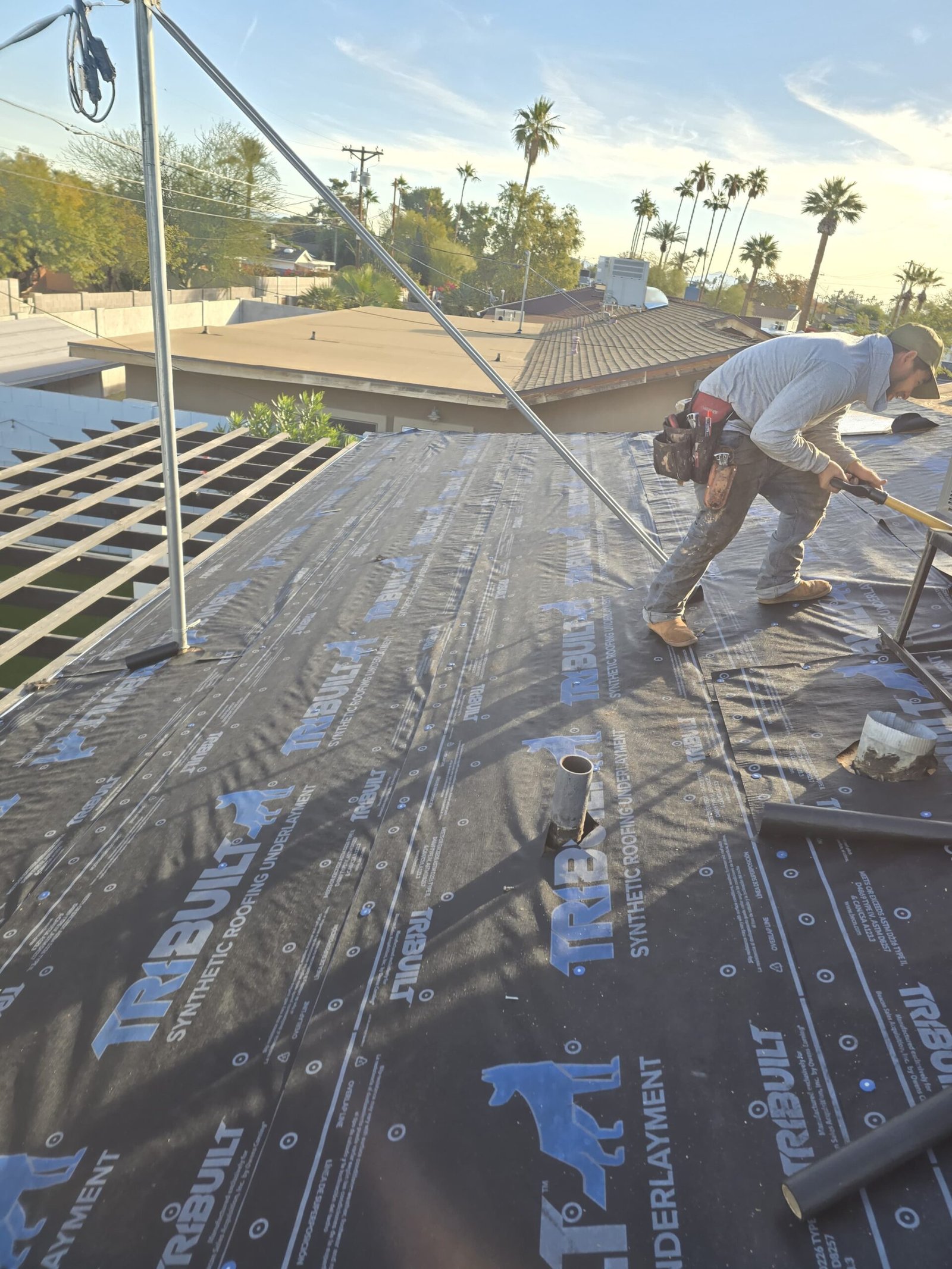
In Phoenix and Scottsdale you can see air conditioners sitting on roofs, which surprises people who grew up with the condenser in the yard. The roof placement is not an Arizona quirk so much as a building-type choice, and it comes with a roofing cost: every unit on a roof is a set of openings, curbs, and service traffic that the roof system has to live with. This guide explains why rooftop AC units are common, and how they cause roof leaks.
Last updated: November 4, 2026. By Lior Gabay, Tip Top Roofing Service, ROC #355034.
Why Is the AC on the Roof in Arizona?
Air conditioners sit on roofs mainly because packaged rooftop units (RTUs) are a standard way to cool commercial and other flat-roof buildings: they save floor space. Many homes use ground or attic equipment instead. The curbs, pipes, and drain lines serving a rooftop unit are common leak points, as Tip Top Roofing Service explains below.
- Consulting-Specifying Engineer (July 10, 2024): Rooftop units save valuable floor space compared with air handling units placed inside a building, and packaged units are off-the-shelf, which keeps cost low. Packaged units range from 2 to 150 tons and suit light commercial buildings such as simple offices and retail. Source: Tony Gonzalez, Consulting-Specifying Engineer, Design of RTUs: Best practices (July 10, 2024).
- U.S. Department of Energy, cited by that article (2024): RTUs cool about 60% of commercial floor space in the U.S. A separate DOE Better Buildings page says nearly half of cooling-conditioned commercial floor space features rooftop units. Sources: Tony Gonzalez, Consulting-Specifying Engineer, Design of RTUs: Best practices (July 10, 2024) and U.S. Department of Energy Better Buildings, High Performance Rooftop Unit Challenge.
- RCI Interface (October 2009): Creating additional penetrations in the roof membrane results in additional potential leak sources. Source: Karl A. Schaack, RCI Interface (October 2009).
- CRCA Technical Bulletin (October 1995): Drainage pans for rooftop units must be positioned and level or water can overflow into the building, and pans and discharge tubes should be inspected and cleaned routinely. Source: CRCA Technical Bulletin Volume 44, Roof Top Equipment (October 1995).
Why does Arizona put AC on the roof?
Published sources explain rooftop units by building type and space, not by Arizona specifically. We did not find a government or industry source measuring how common roof-mounted AC is on Arizona homes. As a general pattern, residential Arizona homes more often have ground-level or attic equipment, while roof-mounted packaged units are most common on commercial and other flat-roof buildings. Arizona heat does shape the equipment: the University of Arizona design standard, for example, sizes rooftop and remote condensers for a 115 degrees F ambient temperature and calls for 3 feet of clearance around them (University of Arizona, Manual of Design and Specification Standards, Section 15780, Packaged Air Conditioners (April 2026)).
Tip Top Roofing Service perspective
When a customer asks why the AC is on the roof, the useful follow-up is what sits under it. A rooftop unit on a flat or low-slope roof means a curb, pipe and wire openings, a condensate path, and technicians walking the roof. Those are the details we check when a leak shows up near the equipment.
Why Rooftop AC Units Are Common on Flat and Low-Slope Roofs
- Space. Putting the unit on the roof frees interior floor space, a point the Consulting-Specifying Engineer article makes for commercial buildings.
- Packaged simplicity. A packaged unit holds the major components in one factory-built cabinet, which keeps cost low for buildings that do not need precise temperature control.
- Building type. The same article ties packaged units to light commercial uses such as simple offices and retail, where cost is the main concern.
- Safety and access rules. The International Mechanical Code section 306.5, as described in that article, requires equipment to sit at least 10 feet from the roof edge or be protected with fall protection, so roof layout is planned around the unit.
How Rooftop AC Units Cause Roof Leaks
Leaks near rooftop units rarely come from the unit itself. They come from the roof details around it. Facility manager B. Kevin Folsom put it plainly in 2012: roof leaks always find their way to the detail areas (B. Kevin Folsom, Today’s Facility Manager (December 12, 2012)). Here are the common starting points and what the published guidance says.
| Leak source | How a leak starts | What the published sources say |
|---|---|---|
| Curb flashing | Water gets past the flashing where the curb meets the roof | Curbs are commonly 12 to 18 inches tall (RCI Interface, 2009); CRCA recommends a curb wall height of at least 300 mm. On standing-seam metal roofs, common curb errors include relying on surface-applied sealants and using a curb designed for steep-slope watershedding on a low-slope roof (Haddock, 2013) |
| Condensate pans and lines | A pan that is unlevel or clogged overflows into the building, which can look like a roof leak | Pans and discharge tubes should be inspected and cleaned routinely (CRCA, 1995) |
| Refrigerant, electrical, and piping penetrations | Each opening in the membrane is another place for water to enter | Additional penetrations mean additional potential leak sources, and for premolded rubber doughnut seals the sealant bond to the pipe is critical (Schaack, 2009). Haddock’s first rule is to avoid penetrating the roof membrane where possible (2008) |
| Vibration and movement | Supports that shift or load the roof unevenly damage the membrane over time | Wood blocking restricts movement and spreads loads poorly, so it can damage the roof even with protection pads (Schaack, 2009) |
| Maintenance traffic | Technicians set tools down, drag equipment, or take the shortest path across the roof | Dropped tools, access panels, oils, and repeated foot traffic can damage the membrane; CRCA recommends walkway pads or pavers around units and along access paths |
| Drainage near the curb | A curb in a valley or near a drain holds back water | Curbs near drains or valleys can obstruct drainage, so saddles or crickets may be needed (CRCA, 1995) |
The pattern across these sources is that small failures add up. A sealant ages, a pan clogs, a technician gouges the membrane, and water gets a path. Arizona’s heat adds thermal cycling that works on flashing and sealants, which we cover in our post on the effect of Arizona heat on flat roofs.
Is the Leak From the AC Unit or the Roof?
- Check the pan and drain first. Overflow from a clogged or unlevel condensate pan can enter the building and look like a roof leak (CRCA).
- Look at where water appears. Stains directly below the unit or its curb point to flashing, penetrations, or the curb. Stains far from the unit suggest a different roof leak source.
- Look for ponding near the curb. Standing water against a curb suggests a drainage issue that needs a saddle or cricket.
- Look at pipe and wire openings. Cracked sealant, torn boots, or loose seals are common entry points.
- Do not guess. Ask a roofer to trace the leak, and ask the HVAC company to check the pan, drain, and lines. Our guide to the common causes of roof leaks in Scottsdale helps you sort the possibilities.
Reducing Leak Risk Around Rooftop Units
- Coordinate trades. Haddock advises that the roofing manufacturer approve all rooftop attachments, penetrations, and curbs, and that long-term weathertightness warranties cover them (Rob Haddock, Roofing Magazine (November 3, 2013)).
- Protect the membrane. CRCA recommends walkway pads, pavers, or other protection around units and along access paths, and a posted notice at roof entrances naming the roofing system so service staff know what precautions to take.
- Repair punctures right away. A Buildings.com column (a sponsored roofing column) notes that setting a toolbox on the membrane is likely to cause puncture damage and advises having a roofer make repairs (Buildings.com, When should the owner initiate rooftop action (June 24, 2004)).
- Inspect on a schedule. NRCA recommends scheduled roof inspections at least twice a year, preferably in spring and fall, plus after severe weather (NRCA, Professional Roofing, A new resource for consumers (November 1, 2020)).
If you already have a leak near rooftop equipment, see our pages on flat roof leak repair in Scottsdale and roof leak repair in Phoenix.
Frequently Asked Questions About AC Units on Roofs
Why is AC on the roof in Arizona?
Rooftop AC is mainly a building-type choice. Packaged rooftop units save floor space, are off-the-shelf and low cost, and suit light commercial buildings and flat roofs. We did not find a source measuring how common roof-mounted AC is on Arizona homes, which more often have ground-level or attic equipment.
Why does Arizona put AC on the roof?
Published sources explain rooftop units by space and building type rather than by state. Rooftop units are common on commercial and flat-roof buildings because they free interior and ground space, and Arizona heat means the equipment is sized for high ambient temperatures.
Can a rooftop AC unit cause a roof leak?
Yes, indirectly. The unit itself rarely leaks into the roof, but the curb flashing, pipe and wire penetrations, condensate pan and drain, vibration, and maintenance traffic around it can all create paths for water.
Where do rooftop AC leaks usually start?
At the roof details around the unit: curb flashing, penetrations, sealants, and areas damaged by foot traffic. A clogged or unlevel condensate pan can also overflow into the building and look like a roof leak.
Do homes in Arizona usually have rooftop AC?
Not usually. As a general pattern, homes more often have ground-level condensers with attic or closet air handlers, while roof-mounted packaged units are most common on commercial and flat-roof buildings. We could not source a count of roof-mounted units on Arizona homes.
Who should fix a leak around a rooftop unit?
A roofing contractor should repair flashing, penetrations, and membrane damage, and an HVAC contractor should check the unit, pan, drain, and lines. Coordinating both is the safest approach, since roof work and equipment work overlap at the curb.
Get a Free Estimate for a Leak Near Your AC Unit
As a local roofing company serving Scottsdale, AZ, Tip Top Roofing Service provides a free estimate for roof leak repair around rooftop equipment, including curb flashing and penetration repairs.
📞 Call Tip Top Roofing Service today at (480) 877-1643
📧 Email: info@tiptoproofingservice.com
🌐 Website: https://tiptoproofingservice.com/
🕓 Hours: Open 7 days, 8 AM to 6 PM (Fridays until 4 PM)
References
- Consulting-Specifying Engineer: Design of RTUs, Best practices (July 10, 2024)
- U.S. Department of Energy Better Buildings: High Performance Rooftop Unit Challenge
- RCI Interface: Karl A. Schaack on rooftop equipment supports and flashing (October 2009)
- CRCA: Technical Bulletin Volume 44, Roof Top Equipment (October 1995)
- Roofing Magazine: Rooftop Equipment Mounting and Penetrations for Low-slope Standing-seam Metal Roofs (November 3, 2013)
- Spaces4Learning: Rooftop Penetrations (March 1, 2008)
- Buildings.com: When should the owner initiate rooftop action (June 24, 2004)
- Today’s Facility Manager via Facility Executive: Tricks of the Trade, Roof Leaks (December 12, 2012)
- NRCA, Professional Roofing: A new resource for consumers (November 1, 2020)
- University of Arizona: Section 15780, Packaged Air Conditioners (April 2026)