Foam roofing is one of the most misunderstood terms in Arizona roofing. Homeowners hear “spray foam” and picture the insulation sprayed inside an attic or wall, while roofers mean a different system: a rigid foam layer sprayed on top of the roof and covered with a protective coating. This guide explains what a foam roof is, how it differs from spray foam insulation, how long spray foam roofing lasts, and how to decide whether foam roofing is worth it, using published industry and government sources.
Last updated: November 4, 2026. By Lior Gabay, Tip Top Roofing Service, ROC #355034.
What Is a Foam Roof?
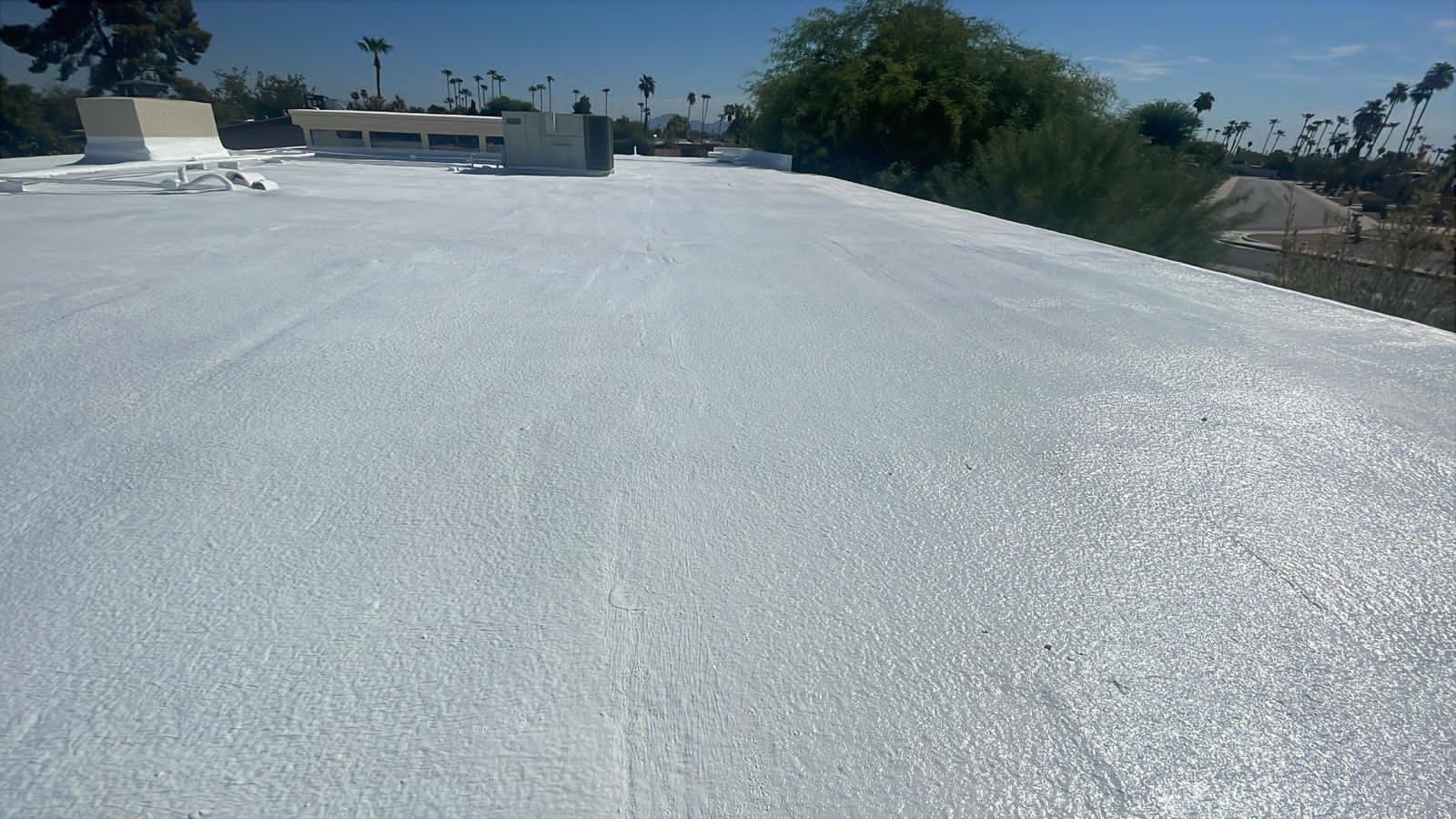
A foam roof is a spray polyurethane foam (SPF) roofing system. Two liquids are sprayed onto the roof and expand into a seamless, rigid, closed-cell layer that insulates and sheds water, then a protective coating shields it from sunlight. Tip Top Roofing Service uses the term for this roof system, not for insulation foam sprayed inside attics and walls.
- IBHS and RICOWI roof guide (accessed November 2026): SPF roofing is a thick, field-applied, rigid, closed-cell foam layer. The guide gives a typical roofing density of 2.5 to 4.0 lb/ft3 and an R-value of about 5.5 to 6.5 per inch, and says a protective coating or covering is necessary. Source: IBHS and RICOWI, Roof Guide: Spray Foam.
- SPFA, Roofing (accessed November 2026): SPF roofing forms a seamless, continuous layer that works as a vapor retarder, weather barrier, air barrier, and continuous insulation. Coverings include elastomeric coatings (acrylic, silicone, butyl rubber, polyurethane, polyurea) or aggregate. Source: Spray Polyurethane Foam Alliance (SPFA), Roofing.
- Journal of Light Construction (October 1, 2006): Roofing foam is denser than wall insulation foam, is closed-cell, and is firm enough to walk on, at about R-6.5 per inch. Source: Journal of Light Construction, Reroofing With Spray Foam (October 1, 2006).
- U.S. Department of Energy Building America (accessed November 2026): Closed-cell spray foam holds over 90% of its cells closed and acts as a vapor retarder at typical thickness. Source: U.S. Department of Energy Building America, Spray Foam Guide.
Tip Top Roofing Service perspective
When people ask us about a foam roof, they usually mean one of two things: the roof surface itself (SPF roofing) or the foam in the attic. Only the first one is a roof. Throughout this guide, “foam roof” means SPF roofing, and “spray foam insulation” means the interior product.
Spray Foam Insulation vs. SPF Roofing
Both products are spray polyurethane foam, which is why the terms get mixed up. The difference is the product formulation, where it is applied, and how it is protected.
| Question | Spray foam insulation | SPF roofing |
|---|---|---|
| Where it goes | Inside walls, attics, and against the underside of a roof deck or rafters (DOE guide) | On top of the roof surface as the waterproofing layer (SPFA) |
| Typical density | About 0.5 lb/cf (open-cell) to 2.0 lb/cf (closed-cell) (DOE guide) | 2.5 to 4.0 lb/ft3 (IBHS and RICOWI guide) |
| R-value per inch | About R-3.6 (open-cell) to R-6.1 (closed-cell) (DOE guide) | About R-5.5 to R-6.5 (IBHS and RICOWI guide) |
| Sun and weather exposure | Covered by the building assembly; depending on the manufacturer, a thermal or ignition barrier may be required (DOE guide) | Exposed, so a protective coating is necessary (IBHS and RICOWI guide) |
| Main job | Insulation and air sealing | Waterproofing, insulation, and air barrier in one layer (SPFA) |
Two points from the Department of Energy guide are worth remembering. First, it states that neither open-cell nor closed-cell spray foam can be treated generically, so suitability depends on each product’s manufacturer evaluation report. Second, it notes that roofs are rigorous service assemblies and are more prone to failure than walls. Foam sprayed under a roof deck insulates the assembly, but the roof covering above it, such as shingles, tile, or a roof membrane, still does the waterproofing. That is not a foam roof.
How a Foam Roof Is Installed
- Prepare the surface. For a recover over an existing roof, one published method sweeps off loose gravel, repairs rotted sheathing, and primes the surface before spraying (Journal of Light Construction, Reroofing With Spray Foam (October 1, 2006)). SPFA says SPF can go on new roofs or over most existing roofs, and the Journal of Light Construction article recommends stripping back to the sheathing when there is more than one layer.
- Spray the foam. The IBHS and RICOWI guide gives 1 inch as the minimum thickness. The Journal of Light Construction describes about 1.5 inches as typical, and The Construction Specifier describes 2 to 3 inches as common (The Construction Specifier, Resisting hail with SPF roofing (October 1, 2015)). The Journal of Light Construction adds that low spots can be corrected by building up extra foam.
- Apply the protective coating. The IBHS and RICOWI guide gives a total dry coating thickness of generally 20 to 40 mils. The coating protects the foam from ultraviolet exposure and is the part of the system that gets re-applied over time.
- Inspect and keep a maintenance record. Industry guidance calls for inspections twice a year and after severe weather (see the maintenance section below).
How Long Does Spray Foam Roofing Last?
Published lifespan figures come mostly from the spray foam industry, so treat them as industry-reported ranges rather than a promise for any one roof. Here is what each source says.
| Source | What it reports |
|---|---|
| IBHS and RICOWI roof guide (accessed November 2026) | Maintained SPF roofs exhibit lifespans in excess of 30 years; coatings need to be re-applied every 10 to 20 years |
| SPFA, Roofing (accessed November 2026) | A lifespan exceeding 20 years with regular care, and as long as 40 years or more with regular inspection and recoating |
| Journal of Light Construction (October 1, 2006) | Recoating typically needed every 10 to 15 years, or up to 20 years with upgraded systems |
| Spray Foam Magazine (July 30, 2023) | Reports studies by Dr. Rene Dupuis of more than 300 SPF roofs: an average of 11 years before recoating in 1997 and 15 years in 2003, with an effective service life of more than 30 years. The authors are tied to the foam industry and the findings are described secondhand |
What moves a roof toward the short or long end of those ranges? The Spray Foam Magazine article says it depends mainly on the quality of the original application and long-term maintenance. The IBHS and RICOWI guide says foam degrades under ultraviolet exposure, which is why the coating matters. And damage that goes unrepaired matters more in a desert: a 2000 IIBEC article by Mason Knowles and Don Best notes that in hot, arid areas, cracks in the coating allow ultraviolet degradation that eventually weakens coating adhesion (IIBEC, Inspection, Evaluation and Repair of SPF Roofing Systems After a Windstorm or Hail Event (2000)).
Tip Top Roofing Service perspective
Think of a foam roof as a coating-maintained system. The foam is the roof, and the coating is the maintenance item. Instead of asking for a single number of years, ask about the recoat cycle and what gets inspected. Our foam roof recoating guide walks through that process for Phoenix-area roofs.
Is Foam Roofing Worth It?
Whether foam roofing is worth it depends on your roof’s shape, condition, and drainage, and on how you weigh the points below. Here is the balanced view from the published sources.
Where foam roofing has real advantages
- No seams. SPFA describes SPF as a seamless, continuous layer, so there are no field seams to open up.
- Built-in insulation. The IBHS and RICOWI guide gives about R-5.5 to R-6.5 per inch of foam.
- Heat reflection with a reflective coating. The Department of Energy says standard or dark roofs can reach 150 degrees F or more in summer sun, a cool roof can stay more than 50 degrees F cooler, and cool roofs deliver their greatest cooling savings in hot climates (U.S. Department of Energy, Energy Saver: Cool Roofs (archived copy)). That statement covers cool roofs generally, not foam alone, but a reflective coating over foam is one way to get a cool roof surface.
- Hail behavior. The IBHS and RICOWI guide says hail and wind-driven debris typically do not cause an SPF roof to leak and that damage can usually be repaired economically. The Construction Specifier reports that more than a dozen SPF systems passed FM Global severe hail testing.
Trade-offs to weigh
- It needs a recoat cycle. Plan for periodic recoating and inspections, as the lifespan table above shows.
- Coating damage should be repaired promptly. Hail typically cracks the coating and dents the top of the foam, with dents usually 1/8 to 3/4 inch deep, and damage can go unnoticed for months or years (Knowles and Best, 2000).
- Cost comparisons come from industry authors. A 2000 life-cycle model by Dr. Theodore Michelsen, described in the Spray Foam Magazine article, found a life-cycle cost advantage for SPF over membrane roofs of 12% to over 59% across a 30-year period, depending on the recoat schedule. The authors of that article are tied to the foam industry, so ask any contractor to price your specific roof instead of relying on a general figure.
Tip Top Roofing Service perspective
In our work, foam is most often considered for flat and low-slope roofs where a seamless layer and added insulation matter. If your roof is pitched, or has ponding or structural concerns, a different system may fit better. Our comparison of asphalt roof replacement vs. foam roof replacement lays out the decision.
Foam Roof Maintenance in Arizona
The maintenance schedule is consistent across sources. The IBHS and RICOWI guide recommends one inspection in spring and one in fall each year, with small punctures repaired using a compatible sealant and clogged drains and gutters cleared. SPFA recommends inspecting twice a year and after severe weather events. NRCA likewise recommends scheduled inspections at least twice a year, preferably in spring and fall, plus additional inspections after a severe weather event such as a hailstorm (NRCA, Professional Roofing, A new resource for consumers (November 1, 2020)). ASTM D6705 is the standard guide covering repair and recoating of SPF roofing (ASTM D6705/D6705M-25, Standard Guide for Repair and Recoat of Spray Polyurethane Foam Roofing Systems).
If you are looking at repair or recoating options, see our pages on foam roofing in Scottsdale and roof coating in Scottsdale.
Frequently Asked Questions About Foam Roofs
What is a foam roof?
A foam roof is a spray polyurethane foam (SPF) roofing system: foam is sprayed onto the roof, expands into a seamless, rigid, closed-cell layer, and is covered with a protective coating. The foam provides insulation and water protection, and the coating protects it from sunlight.
What is foam roofing, and is it the same as spray foam insulation?
No. Foam roofing is SPF applied on top of the roof as the weatherproof layer, at a typical density of 2.5 to 4.0 lb/ft3 and with a protective coating. Spray foam insulation is applied inside walls, attics, or under a roof deck, and its open-cell and closed-cell types have lower typical densities of about 0.5 and 2.0 lb/cf.
How long does spray foam roofing last?
Industry sources report lifespans over 20 years with regular care and in excess of 30 years for maintained roofs, with some saying 40 years or more with inspection and recoating. The coating usually needs to be re-applied every 10 to 20 years, and the figures are industry-reported ranges, not a promise for any one roof.
Is foam roofing worth it?
It can be, depending on the roof. Advantages include a seamless surface, built-in insulation, and a reflective coating option, while trade-offs include recoat cycles and prompt repair of coating damage. Published cost comparisons come largely from industry authors, so a written estimate for your specific roof is the better guide.
Can foam roofing go over an existing roof?
SPFA says SPF can be applied over most existing roofs. One published method sprays foam over an existing membrane when there is only one layer and strips back to the sheathing when there are multiple layers, so the condition of the existing roof decides what is possible.
How often should a foam roof be inspected?
Twice a year, typically in spring and fall, and after severe weather such as a hailstorm. Inspections look for coating cracks, punctures, and clogged drains so that small repairs can be made before ultraviolet exposure damages the foam.
Get a Free Estimate for Your Foam Roof
As a local roofing company serving Scottsdale, AZ, Tip Top Roofing Service provides a free estimate for foam roof repair, recoating, and replacement, and can explain whether SPF roofing fits your roof.
📞 Call Tip Top Roofing Service today at (480) 877-1643
📧 Email: info@tiptoproofingservice.com
🌐 Website: https://tiptoproofingservice.com/
🕓 Hours: Open 7 days, 8 AM to 6 PM (Fridays until 4 PM)
References
- IBHS and RICOWI: Roof Guide, Spray Foam
- Spray Polyurethane Foam Alliance (SPFA): Roofing
- U.S. Department of Energy Building America: Spray Foam Guide
- Journal of Light Construction: Reroofing With Spray Foam (October 1, 2006)
- Spray Foam Magazine: Roofing Lifespans Unveiled (July 30, 2023)
- The Construction Specifier: Resisting hail with SPF roofing (October 1, 2015)
- IIBEC: Inspection, Evaluation and Repair of SPF Roofing Systems After a Windstorm or Hail Event (2000)
- U.S. Department of Energy: Energy Saver, Cool Roofs (archived copy)
- NRCA, Professional Roofing: A new resource for consumers (November 1, 2020)
- ASTM International: D6705/D6705M-25, Repair and Recoat of Spray Polyurethane Foam Roofing Systems