Hail size is the first thing people ask about after a storm, and the honest answer is that it depends on what is on your roof. A quarter-size stone can bruise an aged asphalt shingle but may do little to a concrete tile, while the same stone can leave a cosmetic dent in metal. This guide collects the published thresholds by roof type from Haag Engineering, the Insurance Institute for Business and Home Safety (IBHS), and other research, and states each as a range with the study cited.
Last updated: November 4, 2026. By Lior Gabay, Tip Top Roofing Service, ROC #355034.
What Size Hail Damages a Roof?
Hail about 1 inch across, roughly quarter size, is where damage can begin on older, thinner roofing such as aged three-tab asphalt shingles. Most tile, foam, metal, and flat roof systems generally need larger stones, often 1.5 inches or more, to be damaged. Thresholds vary with age, material, and impact angle. Tip Top Roofing Service summarizes the published ranges below.
- Haag Engineering, 2002: Field surveys found thresholds of 1.00 inch for three-tab asphalt shingles, 1.25 inches for 30-year laminated shingles, 1.75 inches for concrete tiles, and 2.50 inches for gravel-covered built-up roofing. Source: Marshall, Herzog, Morrison, and Smith (Haag Engineering), Hail Damage Threshold Sizes for Common Roofing Materials (2002).
- IBHS, September 29, 2025: Repeated impacts from sub-severe hail (0.7 and 1 inch ice spheres) caused cumulative granule loss that exceeded the loss from a single 2 inch impact for the products tested, and naturally weathered shingles averaged about a 47% performance decline versus new. No dents or tears were observed from the sub-severe impacts. Source: Meisenzahl, Giammanco, and Hedayati (IBHS), Sub-severe hail: the missing piece in assessing asphalt shingle risk in North America (Frontiers in Materials, September 29, 2025).
- National Weather Service (accessed November 2026): Quarter-size hail is 1 inch, which is the NWS severe criterion. Source: National Weather Service, Estimating Hail and Wind.
- Haag Engineering, 2004: In tests of 13 concrete tile products, none fractured at 1 inch, four fractured at the corners at 1.25 inches, six survived 1.5 inches, and 2.5 inches broke all of them. Source: Marshall, Herzog, Morrison, and Smith (Haag Engineering), Hail Damage to Tile Roofing (2004).
Tip Top Roofing Service perspective
There is no single “damaging size” for every roof. Age, material, and impact angle all change the result, and the published research says so. We treat the numbers below as ranges, and we look at the roof itself before saying whether hail caused damage.
Hail Size Reference (NWS)
The National Weather Service describes hail by everyday objects. Use this to translate storm reports into inches.
| Common object | Hail diameter |
|---|---|
| Pea | 1/4 inch |
| Penny | 3/4 inch |
| Nickel | 7/8 inch |
| Quarter | 1 inch (NWS severe criterion) |
| Half dollar | 1 1/4 inches |
| Ping pong ball | 1 1/2 inches |
| Golf ball | 1 3/4 inches |
| Hen egg | 2 inches |
| Tennis ball | 2 1/2 inches |
| Baseball | 2 3/4 inches |
Source: National Weather Service, Estimating Hail and Wind. Arizona gets hail too. KTAR News reported on October 21, 2026 that a supercell storm moved through Chandler and Mesa, with a National Weather Service Phoenix meteorologist describing hail in excess of 1 inch in diameter (KTAR News, Supercell thunderstorm pelts East Valley with rain, hail (October 21, 2026)).
Hail Damage Thresholds by Roof Type
Each row below states a published range and the study behind it. Studies use different methods, such as launched ice balls in a lab or field surveys after storms, so the numbers do not line up exactly.
| Roof type | Published hail size range | Source and notes |
|---|---|---|
| Asphalt shingles (three-tab) | Damage onset around 1.00 inch in field surveys; in lab tests on 11-year-old shingles, 50% of impacts damaged organic-mat shingles at 1.00 inch and 60% damaged fiberglass shingles at 1.25 inches | Haag Engineering, 2002. Aged, thinner shingles were most susceptible |
| Asphalt shingles (laminated) | Field onset around 1.25 inches; in lab tests on 11-year-old shingles, 60% of impacts caused damage at 1.5 inches | Haag Engineering, 2002 |
| Concrete tile | Field threshold 1.75 inches; lab results vary by product, from corner fractures in some products at 1.25 inches to all products breaking at 2.5 inches | Haag Engineering, 2002 and 2004. None of 13 products fractured at 1 inch |
| Clay tile | No fractures at 1.25 inches; all tested tile corners broke at 1.5 inches, and field areas were more impact resistant than edges | Haag Engineering, 2004. One Spanish clay S-tile product was tested |
| Spray foam (SPF) roofing | A basic SPF system generally withstands 1/2 to 1 inch hail, leaving shallow depressions without coating cracks; larger hail causes deeper dents and coating cracks | The Construction Specifier, 2015. In a 2004 RICOWI investigation, 3 of 5 SPF roofs hit by 1 to 2 inch hail had coating fractures, while the 2 undamaged roofs saw 1/2 to 1 inch hail |
| Metal panels | In lab tests, 1.25 to 2.00 inch steel balls left shallow dents about 0.01 to 0.05 inch deep; dents from hail up to about 2.5 inches were generally cosmetic unless a panel split or a seam disengaged | Beckner and Patterson, IIBEC Interface, Fall 2025. Galvalume-coated steel only |
| Flat membranes (TPO, EPDM, PVC, modified bitumen, built-up) | With 2 inch ice balls, 18 of 34 specimens (53%) developed tears or cracks; TPO failed when hit directly over a metal fastener; gravel-covered built-up roofing had a 2.50 inch field threshold | RCI Interface, February 2016; Haag Engineering, 2002. Results include several membrane types, not only single-ply |
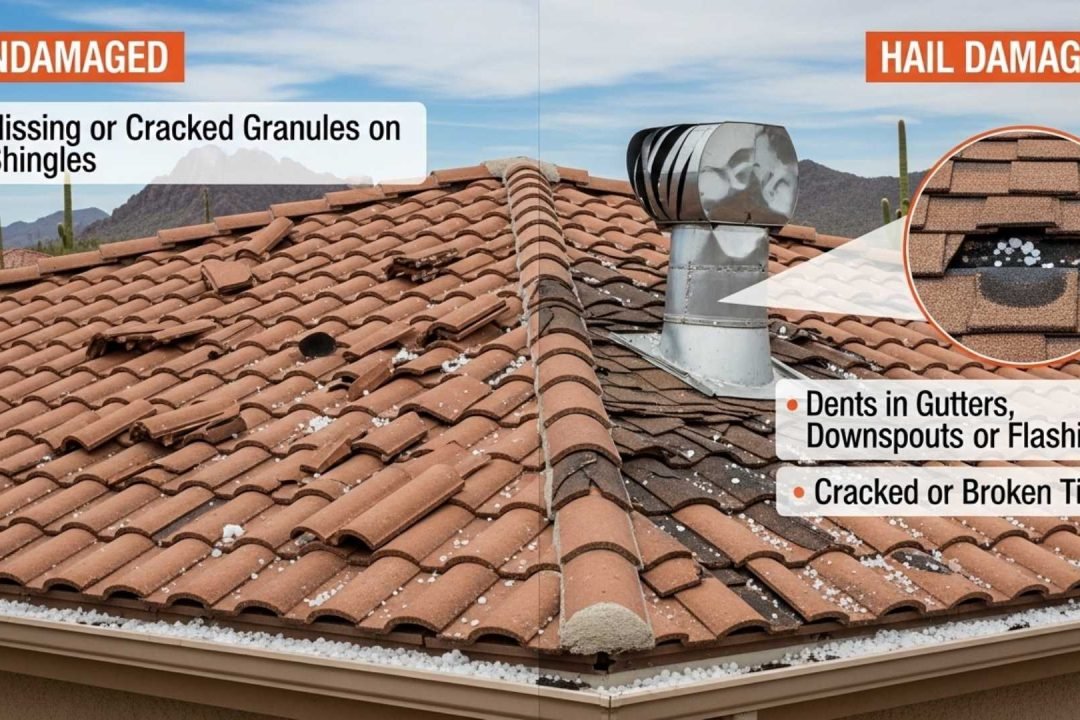
Two cautions apply to every row. First, the Haag Engineering 2002 paper, citing Morrison (1999), defines damage as a reduction in water-shedding ability or in the expected long-term life of the roofing, not just a visible mark. Second, a 2009 field study by EES Group inspectors reported that elevated bruise counts on asphalt shingles appeared at roughly 1.75 to 2 inches (summarized from the published paper), which shows the ranges can differ from one study to the next.
Can 1 Inch Hail Damage a Roof?
Yes, in some cases. Haag Engineering found that 1 inch ice stones damaged half of the aged organic-mat three-tab shingles tested, and its field surveys put the damage onset for three-tab shingles at 1.00 inch. For other materials, 1 inch hail generally did not fracture tile in testing. IBHS adds a different angle: it cites earlier work that hail under 1 inch rarely causes functional damage, but its 2025 tests found that repeated 0.7 and 1 inch impacts can wear granules off shingles, especially weathered ones, even without dents or tears.
Will Quarter Size Hail Damage a Roof?
Quarter size is 1 inch, so the answer is the same: it can, mainly on older or thinner roofing. A newer laminated shingle, a concrete or clay tile, a foam roof with an intact coating, or a metal roof is less likely to suffer functional damage from a single quarter-size stone, though dents in metal and coating cracks in foam are possible. The way to know is a roof inspection, because bruising, granule loss, and hairline coating cracks are easy to miss from the ground.
Is Your Roof Hail Storm Ready?
No roof is hail proof, but published guidance points to a short readiness list.
- Know your roof’s age and condition. In the IBHS tests, naturally weathered shingles lost about 30% to 40% more granules than controls in the sub-severe test series, so older roofs are less ready.
- Ask about impact ratings. IBHS advises choosing shingles with a Class 4 rating under UL 2218, meaning a sample did not crack when hit twice in the same area by a 2 inch steel ball. IBHS also notes that metal may resist cracking but can dent, and that it knows of no rigid product that has achieved Class 4 under FM 4473 (IBHS, Hail: Reducing Risk (Amica co-branded)).
- Schedule inspections. NRCA recommends inspections at least twice a year, preferably spring and fall, plus additional inspections after a severe weather event such as a hailstorm (NRCA, Professional Roofing, A new resource for consumers (November 1, 2020)).
- Do not skip foam roofs. Hail damage to spray foam can go unnoticed for months or years, and in hot, arid areas coating cracks allow ultraviolet degradation (IIBEC, Inspection, Evaluation and Repair of SPF Roofing Systems After a Windstorm or Hail Event (2000)).
After a Hailstorm: Next Steps
Walk the property for dented gutters, vents, and soft metals, take dated photos, and avoid walking on the roof yourself, especially tile. Our guide to how to know if your roof has hail damage covers what to look for, our roof insurance claim guide explains the claim process, and our post-monsoon roof checklist covers storm-season follow-up.
Tip Top Roofing Service perspective
If you suspect hail damage, Tip Top Roofing Service provides a free estimate. We help document damage and meet the adjuster. There is no promise of approval or payment, because that decision belongs to your insurance company.
Frequently Asked Questions About Hail Size and Roof Damage
What size hail damages a roof?
It depends on the roof. In Haag Engineering field surveys, damage thresholds were about 1.00 inch for three-tab asphalt shingles, 1.25 inches for laminated shingles, 1.75 inches for concrete tile, and 2.50 inches for gravel-covered built-up roofing. Age, material, and impact angle change the result.
Can 1 inch hail damage a roof?
It can, mainly on older or thinner roofing. Haag Engineering found 1 inch ice stones damaged half of the aged organic-mat three-tab shingles tested, while concrete tiles did not fracture at 1 inch. IBHS also found repeated 1 inch impacts can wear granules from shingles without dents or tears.
Will quarter size hail damage a roof?
Quarter size is 1 inch, so it can damage older asphalt shingles but is less likely to fracture tile or damage a newer laminated shingle. Dents in metal and coating cracks in spray foam are still possible, so a roof inspection is the way to know.
Does hail damage tile roofs?
Larger hail can. In Haag Engineering tests, none of 13 concrete tile products fractured at 1 inch, four fractured at the corners at 1.25 inches, and 2.5 inches broke all of them, while clay tile corners broke at 1.5 inches. Tile edges were more vulnerable than the field of the tile.
Can hail damage a foam roof?
Yes. Hail typically cracks the coating and dents the top of the foam. A basic spray foam system generally withstands 1/2 to 1 inch hail, and larger hail causes deeper dents and more frequent coating cracks. Damage can usually be repaired if it is addressed promptly.
Is my roof hail storm ready?
Roof age and condition, impact ratings such as UL 2218 Class 4 for shingles, and regular inspections all matter. NRCA recommends inspections at least twice a year and after severe weather such as a hailstorm, since hail damage is often hard to see from the ground.
Get a Free Estimate After a Hailstorm
As a local roofing company serving Scottsdale, AZ, Tip Top Roofing Service provides a free estimate for hail-related roof repair and replacement, and we help document damage and meet the adjuster. We make no promise of approval or payment.
📞 Call Tip Top Roofing Service today at (480) 877-1643
📧 Email: info@tiptoproofingservice.com
🌐 Website: https://tiptoproofingservice.com/
🕓 Hours: Open 7 days, 8 AM to 6 PM (Fridays until 4 PM)
References
- Haag Engineering: Hail Damage Threshold Sizes for Common Roofing Materials (AMS, 2002)
- Haag Engineering: Hail Damage to Tile Roofing (AMS, 2004)
- IBHS authors: Sub-severe hail, Frontiers in Materials (September 29, 2025)
- National Weather Service: Estimating Hail and Wind
- IIBEC Interface: A Deep Dive into Hail-Caused Dents (Fall 2025)
- The Construction Specifier: Resisting hail with SPF roofing (October 1, 2015)
- RCI Interface: ASTM D08 symposium summary (February 2016)
- IBHS: Hail, Reducing Risk (Amica co-branded)
- NRCA, Professional Roofing: A new resource for consumers (November 1, 2020)
- IIBEC Interface: Petty and Kasberg hail study (May 2009)
- IIBEC: Inspection, Evaluation and Repair of SPF Roofing Systems After a Windstorm or Hail Event (2000)
- KTAR News: Supercell thunderstorm pelts East Valley with rain, hail (October 21, 2026)