Arizona is not a state most people associate with hail — but it should be. The Phoenix metro, Tucson, Sedona, Flagstaff, and communities throughout the state experience hail events every year during monsoon season, which runs from June 15 through September 30. In September and October 2025 alone, hailstones measuring up to 2.5 inches in diameter struck parts of central Phoenix, Scottsdale, Tempe, and Chandler in a single storm event. Hail of that size can destroy a roof in minutes.
The challenge for Arizona homeowners is that hail damage is rarely obvious. Unlike a missing shingle or a visible crack you can spot from the driveway, most hail damage is subtle — bruised shingles that look intact, hairline fractures in tile that only show water intrusion weeks later, granule loss that appears gradual rather than sudden. By the time an Arizona homeowner notices a ceiling stain or an active leak, the damage has usually been working its way through the roofing system for months.
This guide tells you exactly what to look for, material by material, so you can make an informed decision about whether your Arizona roof needs a professional inspection after a hail event — and what happens if you wait.
Why Hail Damage in Arizona Is Different
Hail damage anywhere is serious. In Arizona, it is compounded by factors that accelerate the consequences in ways that do not apply in milder climates.
Arizona hail is often wind-driven. Monsoon storms in Arizona arrive with high winds — sometimes exceeding 60 mph — that drive hailstones at an angle rather than straight down. Wind-driven hail strikes roofing surfaces at greater velocity and from directions that expose vulnerable areas like rakes, eaves, and the leeward side of the roof that standard straight-down hail would largely miss.
UV exposure accelerates post-impact deterioration. In most climates, a bruised or compromised shingle might degrade slowly over years. In Arizona’s intense UV environment, a shingle whose protective granule layer has been disrupted by hail impact can deteriorate dramatically within a single summer. What is a moderate damage situation in Ohio becomes an urgent situation in Scottsdale because Arizona’s sun works on the compromised area continuously and aggressively. Our guide on why Arizona roofs fail faster than homeowners expect covers this acceleration effect in full detail.
The insurance filing window is limited. Most Arizona homeowner’s insurance policies require hail damage claims to be filed within a specific timeframe after the storm event — often one year. Homeowners who do not inspect promptly, discover damage months later, and then attempt to file a claim after the window has closed lose their coverage entirely. Prompt inspection after any significant storm is not just a maintenance decision — it is an insurance decision.
The next monsoon storm tests every weak point. In Arizona, hail damage discovered after a July storm will face additional monsoon events in August and September. Every vulnerability the hail created becomes a guaranteed leak point under the next significant rainfall. What could have been a repair becomes water intrusion into insulation, framing, and drywall that compounds the original damage significantly.
How to Check for Hail Damage: Start From the Ground
You do not need to climb on your roof to gather meaningful evidence that hail damage has occurred. A ground-level assessment of your entire property — not just the roofline — gives you important information before calling for a professional inspection.
Check Gutters and Downspouts First
Gutters are one of the most reliable early indicators of hail impact on a shingle roof. After a hail event, check your gutters for an unusual accumulation of granules — the small, dark, sand-like material that makes up the protective coating on asphalt shingles. Some granule presence in gutters is normal, especially on aging roofs. A significant sudden accumulation immediately following a storm is a clear signal that hail impact has dislodged granules across a meaningful area of your shingle surface.
Also check downspouts for dents. Aluminum gutters and downspouts dent visibly from hail impact. If hail was large enough to dent your gutters, it was large enough to bruise your shingles or crack your tile.
Inspect HVAC Units, Vents, and Other Roof-Level Equipment
Walk around your home and look at any equipment mounted on or adjacent to the roof — HVAC condenser units, satellite dishes, roof vents, skylights, and solar panel mounting hardware. These metal components dent, chip, and crack visibly from hail impact. If your AC condenser fins show fresh denting or your skylights show new cracks or chips around the frame, the same storm reached your roofing surface. This is one of the most reliable cross-checks for hail damage that is not yet visible on the roof itself.
Look at Exterior Surfaces at Eye Level
Check your window screens for small round punctures or tears. Check painted surfaces on trim, fascia, and siding for fresh chips or marks. Examine your patio cover surface for impact marks. These collateral damage indicators at eye level are evidence of the same hail event that struck your roof — and they are often easier to see and photograph than rooftop damage.
Look Up at the Roofline From the Ground
From the ground, look specifically for:
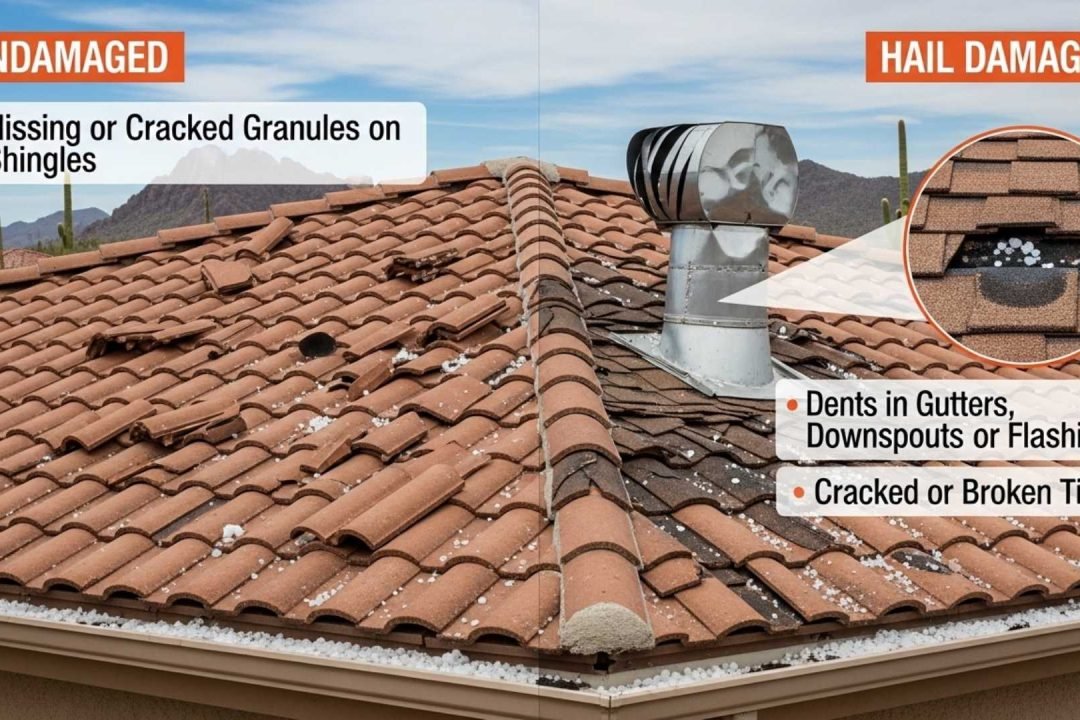
- Missing, cracked, or visibly displaced tiles
- Dark patches or bald spots on shingle surfaces where granules have been stripped
- Visible cracks along the ridge line or at tile edges
- Any section of roof where the surface color or texture looks inconsistent with surrounding areas
- Dented or damaged flashing visible around chimneys, vents, or skylights
Be aware that most significant hail damage on shingles — particularly bruising — is not visible from the ground. A ground-level check that reveals nothing does not confirm your roof is undamaged. It simply means you have not ruled out damage. A professional inspection on the roof surface is the only way to know with certainty.
Hail Damage Signs by Roofing Material
What hail damage looks like depends entirely on what your roof is made of. Arizona’s dominant roofing materials each show hail impact in different ways — and each requires a different inspection approach.
Asphalt Shingles: What Hail Damage Looks Like
Asphalt shingles are the most vulnerable of Arizona’s common roofing materials to hail impact, and they show damage in several distinct ways depending on hail size and impact velocity.
Granule loss. This is the most common and earliest sign of hail damage on shingles. Hailstones act like sandpaper on impact, scouring protective granules from the shingle surface. The granules themselves are not cosmetic — they are the primary UV shield protecting the underlying asphalt. Once granules are displaced, the exposed asphalt deteriorates rapidly under Arizona’s sun. Granule loss appears as dark patches, bald spots, or areas where the shingle surface looks inconsistently textured compared to undamaged sections.
Shingle bruising. This is the most dangerous and most missed form of hail damage on asphalt shingles. When hailstones strike with significant force, they can impact the internal fiberglass mat and asphalt layers without visibly cracking the shingle surface. The result is a soft spot — a bruise — where the shingle’s structural integrity has been compromised but the damage is not visible to casual inspection. These bruised areas become active failure points under subsequent heat cycles and rain events. Bruising can only be reliably identified by an inspector physically pressing on shingle surfaces.
Cracked or split shingles. Larger hailstones — 1 inch or more in diameter — can crack or split shingle surfaces outright. Cracked shingles have immediately lost their waterproofing function. Any area of cracked shingles should be treated as an active leak risk for the next rain event.
Missing shingle tabs. High-velocity or wind-driven hail can tear shingle tabs away from the roof surface entirely, leaving the underlayment directly exposed. This is visible from the ground and represents an urgent repair situation.
Tile Roofs: What Hail Damage Looks Like
Clay and concrete tile is more resistant to hail than asphalt shingles, but it is not immune — particularly from larger hailstones or wind-driven impact. Tile hail damage is also more deceptive because the visible tile surface often conceals damage to the underlayment beneath it.
Hairline cracks. Hail impact on tile frequently produces hairline fractures that are invisible from the ground and difficult to see even on close inspection without knowing what to look for. These hairline cracks allow water to seep through to the underlayment where it sits, causes rot or mold, and creates active leak points that appear at the interior ceiling weeks or months after the storm — often when a second rain event saturates the already-compromised area.
Visible tile fractures. Larger hailstones produce visible breaks or chips in tile surfaces. Any visible fracture in a tile is a confirmed water entry point and should be addressed promptly.
Displaced or loosened tiles. Hail impact, particularly when combined with wind, can loosen tiles from their fasteners without breaking them. Loosened tiles shift under subsequent wind events and eventually expose the underlayment beneath. This displacement is difficult to identify without getting on the roof and physically checking tiles in the impact area.
Underlayment exposure. If hail breaks through tile in any area, the underlayment beneath is directly exposed to UV and subsequent rain. Given that many Arizona tile roofs already have aging underlayment, any underlayment exposure following a hail event is an urgent situation requiring immediate professional attention.
Metal Roofing: What Hail Damage Looks Like
Metal roofing is the most hail-resistant of Arizona’s common residential roofing materials — particularly standing seam metal, which has no exposed fasteners or seams for hail to exploit. However, metal roofing is not immune, and the damage it sustains is often cosmetic rather than functional. Our guide on metal roofing in Arizona covers its full performance profile.
Denting. Metal roofing dents from hail impact. On standing seam systems, denting is typically cosmetic — it does not compromise the roof’s waterproofing function. On metal roofing with exposed fasteners or older metal systems, denting can stress seals and fastener points in ways that create leak paths over time.
Coating damage. Metal roofing relies on its protective coating for corrosion resistance and UV performance. Hail impact that chips or scours the coating in multiple locations creates corrosion initiation points that eventually compromise the metal underneath. This is not immediately obvious but becomes a long-term performance issue.
Flat and Foam Roofs: What Hail Damage Looks Like
Spray polyurethane foam roofing and flat membrane systems — common on Arizona patio covers, additions, and commercial properties — show hail damage in ways that can be particularly difficult to detect without professional assessment. Our guide on flat roofs in Arizona covers the full maintenance requirements for these systems.
Foam surface impact craters. Hail striking foam roofing surfaces can create small impact craters that break through the protective elastomeric coating layer and expose the foam underneath to UV and moisture. These craters are small and easily missed during a casual visual check but allow water absorption into the foam that progressively compromises the system.
Membrane punctures. TPO, modified bitumen, and built-up roofing systems can be punctured by larger hailstones — creating direct water entry points that are invisible until the next rain drives water through the opening.
The Difference Between Hail Damage and Normal Wear
One of the most common questions after a hail event is whether what you are seeing is actually hail damage or just the normal aging of an older roof. Here is how to distinguish the two.
Hail damage has a random, scattered pattern across the roof surface — because hailstones fall randomly, the resulting damage is distributed without uniformity across the roof plane. Normal wear tends to follow a pattern — concentrated on south-facing slopes with maximum sun exposure, in valleys where water flows, or along ridge lines where UV exposure is highest.
Hail damage appears suddenly after a known storm event. Normal wear develops gradually over months and years. If you have photographs of your roof from a year ago that show no granule loss or surface irregularities, and those irregularities appear now following a storm, they are storm damage.
Hail damage shows corresponding impact evidence on other property surfaces — gutters, AC units, screens, siding. Normal wear is isolated to the roof. If your gutters show no denting and your AC unit is undamaged, the roof damage you see is more likely wear than storm impact.
A professional roof inspection that documents these patterns with photographs is the most reliable way to establish what is storm damage versus pre-existing wear — and that documentation is exactly what insurance adjusters require when evaluating a claim.
Interior Signs That Hail Damage Has Already Progressed
If any of the following are present inside your home after a hail event, damage has already moved beyond the roof surface and into the structure. Do not wait to call for an inspection:
- Water stains or discoloration on interior ceilings — even small ones
- Water stains on interior walls, particularly in upper rooms or near the roofline
- Damp insulation visible in the attic
- Daylight visible through attic boards or decking
- Musty or damp odors in upper rooms or attic spaces
- Water pooling or damp areas near skylights or HVAC penetrations
Interior water signs mean the roofing system has already been breached. The hidden cost of ignoring roof damage escalates sharply once water reaches the structure — insulation replacement, drywall repair, and mold remediation are all downstream consequences of delayed action on a roof breach that was already present.
What to Do After a Hail Event in Arizona: Step by Step
Step 1 — Conduct a ground-level assessment. Walk the property perimeter immediately after the storm. Check gutters, downspouts, HVAC units, window screens, and exterior surfaces for evidence of hail impact. Photograph everything you find.
Step 2 — Document the storm event. Note the date and time of the storm. Check local weather service records for hail size reports in your zip code — the National Weather Service and local news sources document significant hail events by location. Having the storm documented independently strengthens any future insurance claim.
Step 3 — Schedule a professional inspection promptly. Do not wait weeks or months. Schedule a professional roof inspection within days of a significant hail event. Most hail damage is not visible from the ground, and only an inspector who physically assesses the roof surface will find bruising, hairline cracks, and coating damage. Our guide on how regular inspections prevent thousands in storm damage covers exactly what a post-storm inspection should include.
Step 4 — Get a written inspection report with photographs. Before contacting your insurance company, have a written inspection report from a licensed roofing contractor that documents all damage found, the specific roof areas affected, and photographic evidence. This report is your most important asset when filing a claim.
Step 5 — Contact your insurance company. File your claim promptly. Most Arizona homeowner’s policies cover hail damage from a covered storm event. For a full breakdown of what Arizona home insurance covers for roof damage, see our dedicated guide. Your contractor’s inspection report supports your claim and ensures the adjuster does not miss damage that was documented during the professional inspection.
Step 6 — Do not accept a settlement without a second look. Insurance adjusters are not roofing contractors. If your adjuster’s assessment significantly differs from your contractor’s inspection report, you have the right to challenge the assessment. An experienced roofing contractor who handles insurance claims regularly will help you navigate this process.
Hail Damage on Your Arizona Roof? Tip Top Roofing Service Is Ready
Tip Top Roofing Service is a GAF-certified, BBB-accredited roofing contractor with over 10 years of experience serving the Phoenix metro and Arizona communities. We inspect roofs after hail events, document all damage with written reports and photographs, and work directly with insurance adjusters to ensure every covered damage item is properly identified and accounted for.
What you get when you work with us:
- Free post-storm roof inspection — no pressure, no obligation
- Written inspection report with photographs suitable for insurance filing
- Licensed and insured in Arizona: ROC License #355034
- Direct insurance adjuster coordination and claim support
- Free estimates for new roof installations
- 0% interest financing over 12 months — learn more about financing a new roof in Arizona
- Up to 30-year material warranties on qualifying systems
- Same-day or next-day response for urgent post-storm situations
- More than 100 five-star Google reviews from verified Arizona homeowners
We serve Chandler, Mesa, Gilbert, Scottsdale, Phoenix, Tempe, Goodyear, Surprise, and 40+ Arizona cities.
Call (480) 877-1643 or email info@tiptoproofingservice.com to schedule your free hail damage inspection today.
Frequently Asked Questions: Hail Damage on Arizona Roofs
How do I know if the damage I see is from hail or just normal wear?
Hail damage appears suddenly after a known storm event, follows a random scattered pattern across the roof rather than concentrated in specific high-wear areas, and is usually accompanied by corresponding impact damage on gutters, AC units, and exterior surfaces. Normal wear develops gradually, is concentrated on high-UV-exposure areas like south-facing slopes, and does not correspond with storm-event timing. A professional inspector with photo documentation can establish the pattern clearly and differentiate storm damage from pre-existing wear — which is essential for insurance purposes.
My roof is not leaking after the hail storm. Does that mean it is fine?
Not necessarily — and this is one of the most important things Arizona homeowners need to understand. Most hail damage does not create immediate leaks. Bruised shingles, hairline-cracked tiles, and compromised coating on foam or metal may look intact and hold water initially. The damage those impact points represent accelerates deterioration under Arizona’s UV and heat, and the next significant rain event often reveals what the hail storm created. Discovering damage after the next monsoon — weeks after the hail event — can put you outside your insurance filing window. Schedule an inspection promptly after any significant hail event regardless of whether you see an active leak.
What hail size causes roof damage in Arizona?
As a general guideline, hail of 1 inch in diameter or larger — roughly the size of a quarter — is sufficient to cause functional damage to asphalt shingles and tile roofing. Hail under 1 inch may cause granule loss on aging shingles or impact damage to more fragile materials like skylights and roof vents without creating structural damage to the main roofing surface. Wind speed and direction significantly affect damage potential — wind-driven hail of 0.75 inches can cause more damage than straight-falling 1.25-inch hail depending on impact angle and velocity.
How long do I have to file a hail damage insurance claim in Arizona?
Most Arizona homeowner’s insurance policies require storm damage claims to be filed within one year of the storm event, though specific timeframes vary by policy and insurer. Review your policy promptly after any significant hail event and do not assume you have unlimited time. The practical recommendation is to schedule an inspection within days of the storm, obtain a written inspection report, and file your claim as soon as the damage is documented. Waiting months before inspecting and filing significantly increases the risk of missing the filing window.
Can I repair hail damage myself?
We strongly advise against it for several reasons. First, DIY repairs on a damaged roof can void manufacturer warranties on your roofing materials. Second, improper repairs can create new water entry points while leaving original damage unaddressed. Third, if an insurance claim is involved, unauthorized repairs before the adjuster inspects may complicate your claim. Schedule a professional inspection, obtain a written estimate, and let a licensed contractor handle repairs — both for quality and for insurance documentation purposes.
Does homeowner’s insurance cover hail damage in Arizona?
Yes — hail damage from a covered storm event is one of the most common covered perils under Arizona homeowner’s insurance policies. The key requirements are that the damage resulted from a specific identifiable storm event, that the claim is filed within the policy’s required timeframe, and that the damage is documented by a professional inspection. For everything you need to know about what Arizona home insurance covers for roofing, see our complete guide. Tip Top Roofing Service works directly with adjusters on behalf of Arizona homeowners to ensure all covered damage is properly identified and included in the claim.
Tip Top Roofing Service | (480) 877-1643 | info@tiptoproofingservice.com | tiptoproofingservice.com | 6830 E 5th Ave #205, Scottsdale, AZ 85251 | ROC License #355034