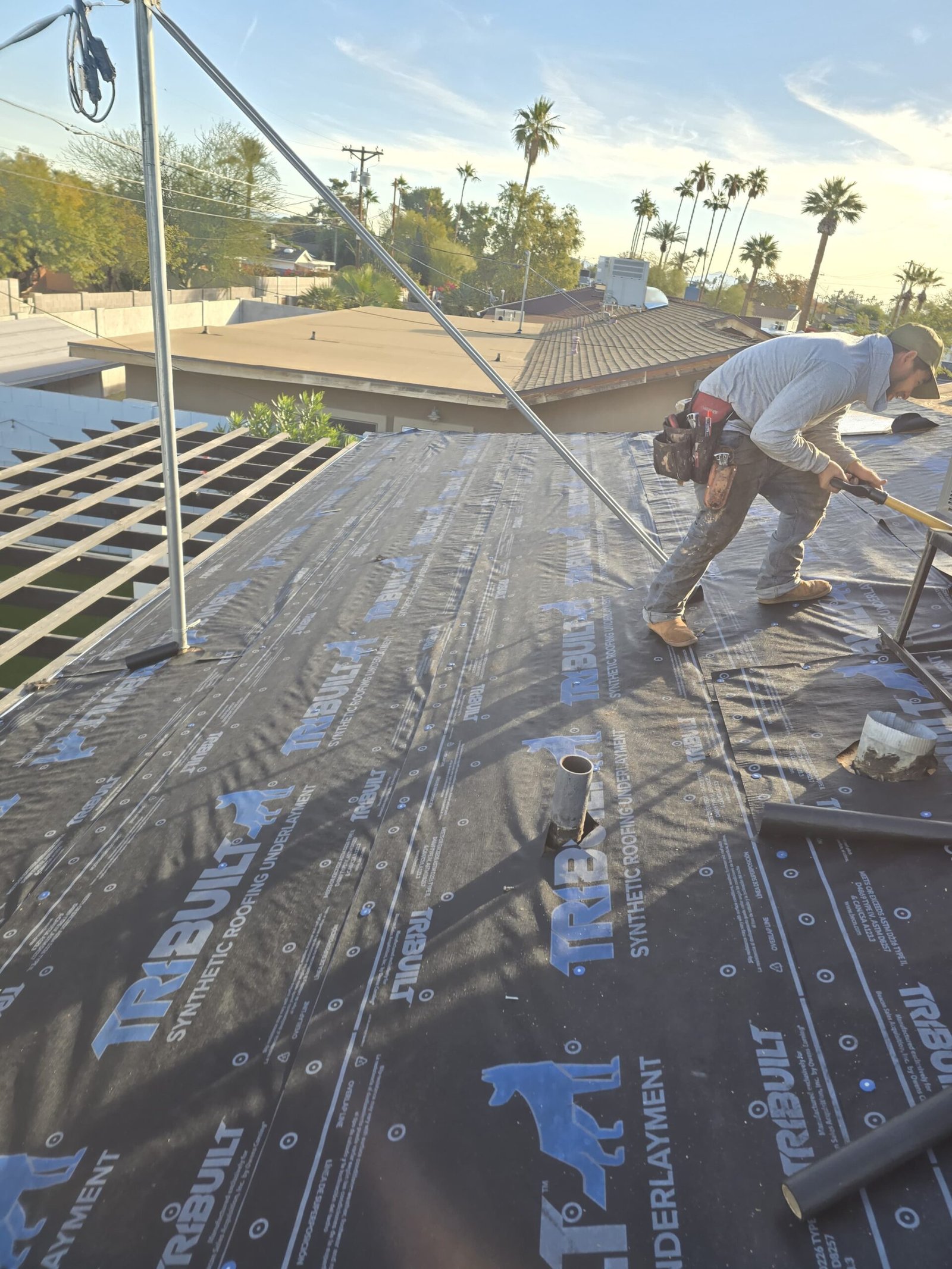
Concrete and clay tile can look perfect from the street while the waterproofing layer underneath is wearing out. That layer is the underlayment, and on a Scottsdale or Phoenix roof it often reaches the end of its service life long before the tiles do. This guide explains why that happens, what a tile-off, underlayment replacement, and tile-reset job involves, and what to ask a contractor before you sign.
Last updated: November 4, 2026. By Lior Gabay, Tip Top Roofing Service, ROC #355034.
How Long Does Tile Roof Underlayment Last in Arizona?
In Arizona’s desert heat, standard tile roof underlayment is expected to last about 15 to 20 years, well short of the tile itself, according to a 2012 reserve-study article. Replacing it means lifting the tiles, installing new underlayment and flashings, and resetting the tiles. Tip Top Roofing Service explains the process below.
Published sources give a range rather than one number, and they agree on the direction: the underlayment is the short-lived part of a tile roof.
- Association Reserves (May 2012): Standard underlayment has a general useful life of about 25 years depending on climate exposure, and in desert areas expected life is closer to 15 to 20 years due to excessive heat. The article calls underlayment and flashings the critical components of weatherproofing. Source: Carl A. Brown, Association Reserves, Lifetime Tile Roofs: Fact or Fiction (May 2012).
- Bob Vila (2018, updated 2020): The underlayment material will need to be replaced every eight to 20 years, and the work involves removing the tiles, replacing the underlayment, and reinstalling the tiles. Source: Bob Vila, Tile Roofs (originally January 12, 2018, updated September 21, 2020).
- BuildingAdvisor (October 5, 2015): Tile more often than not outlives the underlayments and flashings under it. Source: BuildingAdvisor, Best Underlayment for Tile Roofs (October 5, 2015).
- Association Reserves (February 6, 2019): The author found many older tile roofs needed underlayment replacement because of age, dryness, brittleness, and a lack of waterproof membrane performance, and concluded that an underlayment replacement project is a responsible expectation for tile roof owners. Source: Robert M. Nordlund, Association Reserves, Should We Reserve for Tile Roof Replacement? (February 6, 2019).
Why Underlayment Fails Before the Tile in Desert Heat
Tile is fired clay or cast concrete. Underlayment is usually a sheet of asphalt-saturated felt or a membrane, and asphalt reacts to heat. Matt Power of Green Builder Media wrote in January 2025 that roofs approach daytime temperatures of nearly 200 degrees F, and that asphalt-saturated felt may begin to soften or degrade at short-term temperatures around 180 degrees F, with sustained exposure near those limits leading to asphalt bleed and loss of structural integrity (Matt Power, Green Builder Media, 4 Roof Underlayment Types That Can Take the Heat (January 21, 2025)). That article does not single out tile roofs or Arizona, so read it as general background.
The Association Reserves author reaches the Arizona-relevant conclusion directly: the weatherproofing elements have a shorter useful life than the concrete or clay itself, and in desert areas that useful life is closer to 15 to 20 years (Carl A. Brown, Association Reserves, Lifetime Tile Roofs: Fact or Fiction (May 2012)). Moisture can also speed things along. InterNACHI notes that dirt accumulating on the uphill side of battens can retain moisture that accelerates deterioration of the underlayment (InterNACHI, Inspecting Tile Roofs student course book (2012)). Our post on felt, synthetic, and self-adhering underlayment covers the products themselves.
Tip Top Roofing Service perspective
The tiles are what you see, so they get the credit. The underlayment is what keeps water out when wind-driven monsoon rain gets under a tile. When we are asked to look at an older tile roof, we separate two questions: are the tiles reusable, and is the layer beneath them still doing its job? You can answer yes to the first and no to the second. Our free estimate treats them as separate questions.
Signs Your Tile Roof Underlayment May Need Replacing
- Age. The Association Reserves author advises that roofs over 25 years old be evaluated by a roof professional (Carl A. Brown, Association Reserves, Lifetime Tile Roofs: Fact or Fiction (May 2012)).
- Interior water stains with no broken tiles. Tile is a water-shedding layer, and the underlayment is the backup. Stains can mean water is getting past both.
- Flashing wear. BuildingAdvisor notes flashing may start failing in as little as 15 years (BuildingAdvisor, Should I Repair or Replace an Older Tile Roof? (July 11, 2022)). Flashings are usually replaced along with the underlayment.
- Slipped or displaced tiles. InterNACHI lists missing fasteners and failed adhesive as reasons tiles slide down the roof slope, and displaced or missing tiles are one of its end-of-life clues for concrete tile (InterNACHI, Inspecting Tile Roofs student course book (2012)).
- Brittle, dry material found during any repair. When a roofer lifts a few tiles for a repair and sees dry, cracking underlayment, the problem is not limited to that spot.
Not every leak means a full underlayment job. Our guides on finding and fixing a tile roof leak in Scottsdale and cracked tile repair cover when a local repair is enough. Please avoid stepping on the roof to check. InterNACHI advises not walking clay tile unless you know the product well, and our post on walking on a tile roof in Arizona explains why.
Underlayment Options Compared
If your underlayment is replaced, the product choice matters. Here is what the published sources say about the main types.
| Type | What the sources say | What to watch for |
|---|---|---|
| Asphalt felt (30-pound) | BuildingAdvisor (2015) describes two layers of ASTM 30-pound felt as the minimum under tile. Green Builder Media (2025) says felt may soften around 180 degrees F at short-term exposure | BuildingAdvisor (2022) advises avoiding traditional asphalt felt because quality has diminished over the years |
| SBS-modified asphalt sheets | Presented in 2015 as a heavier-duty upgrade over felt. BuildingAdvisor (2019) names a double layer of G40, a 40-pound modified-asphalt sheet, as a minimum for a reroof | Ask for the product name and rating, not just the category |
| Synthetic underlayment | Described in 2015 as lighter and more tear-resistant, with uncertain long-term life. Green Builder Media (2025) says many synthetics are rated for 240 to 260 degrees F | BuildingAdvisor (2022) says synthetics are very waterproof but do not seal well around nail holes, which can cause leaks with tile. InterNACHI says synthetic may void the warranty with some tiles |
| Self-adhering membrane | Recommended in 2015 for valleys, eaves, and other trouble spots, and it seals around nail holes and penetrations | Removal is difficult or impossible at a later reroof (BuildingAdvisor, 2015 and 2022) |
Steps in a Tile-Off, Underlayment Replacement, and Tile-Reset Job
Contractors call this job a tile reset, lift and relay, or reroof with tile reuse. The sequence is similar.
- Plan the roof loading. Tile is heavy. Bob Vila gives a range of 580 to nearly 1,100 pounds per square for tile roofs. BuildingAdvisor advises spreading reused tile around to avoid overloading the roof structure, so staging should be planned before work starts.
- Remove the tiles. Tiles are lifted off in sections and set aside for reuse, with spares set aside to cover breakage.
- Remove the old underlayment. This exposes the roof surface so the contractor can see what is under the old layer.
- Replace the underlayment and flashings. The Association Reserves article says these roofs will at minimum need a tile reset with all new underlayment and flashings, reusing the old tile. BuildingAdvisor (2019) says that at 30 years old, all flashings and battens should be replaced along with the tiles.
- Reinstall the tiles. The saved tile goes back on, with replacements for any broken pieces.
- Final check. The contractor walks the finished roof, checks flashing details and tile fastening, and cleans up.
Two points from the sources deserve attention. First, breakage: the 2012 Association Reserves article allows for about 30 percent breakage of old tile in the process, while the 2019 article uses about a 5 percent breakage factor. That spread is why you should ask how a contractor plans for breakage and matching. Second, reuse is not always wise. BuildingAdvisor (2019) notes reused tile carries no new product warranty, and BuildingAdvisor (2022) says that if tiles are more than 20 or 30 years old, it rarely makes economic sense to reuse them. The same 2019 article puts the savings from reusing tile at roughly 20 to 25 percent compared with new tile.
To see how this looks on a real house, view our tile roof reset and underlayment replacement project. Local service pages cover tile roof underlayment replacement in Scottsdale, Phoenix, and tile roof reset in Scottsdale.
What to Ask a Contractor Before You Sign
- Is the license active and the right class? The Arizona Registrar of Contractors says to make certain the license class allows for the work in the contract, and that the only sure way to know a contractor is licensed is to call the Registrar to confirm it (Arizona Registrar of Contractors, Before You Hire a Contractor (accessed November 4, 2026)).
- Is everything in writing? The Registrar advises a written contract that includes all services, the contractor’s license number, start and completion dates, the price, and who obtains building permits.
- Do you have several estimates? The Registrar advises asking for written estimates from at least three contractors, and checking references.
- Which underlayment, and what temperature rating? Ask for the product name and confirm it suits your tile and warranty.
- How will you handle breakage and matching? Ask how many spare tiles are on hand and what happens if a match is not available.
- How will tile be staged on the roof? This ties back to roof loading.
- What happens if decking problems are found? Ask how any needed decking repair is documented and priced before it proceeds.
- Insurance and bonding? The Registrar says licensing requires a bond, and apart from workers’ compensation it does not require a licensed entity to carry insurance, so ask for proof.
Tip Top Roofing Service is GAF-certified, Owens Corning certified, BBB-accredited, and licensed in Arizona under ROC #355034, and you can verify the license yourself with the Registrar. For a broader look at tile, see our guides to concrete tile versus clay tile in Arizona and tile roofing services.
Frequently Asked Questions About Tile Roof Underlayment Replacement
How long does tile roof underlayment last in Arizona?
One reserve-study article puts standard underlayment at about 25 years in general and closer to 15 to 20 years in desert areas because of excessive heat. Bob Vila gives a wider range of eight to 20 years. Treat these as planning ranges, since product type and roof exposure matter.
Why does underlayment wear out before the tile?
Tile is made of fired clay or concrete, while underlayment is typically an asphalt-based sheet exposed to heat and moisture. Published sources describe tile more often than not outliving the underlayments and flashings, and desert heat shortens underlayment life further.
Can the tiles be reused during underlayment replacement?
Often yes. The tiles are lifted, the underlayment and flashings are replaced, and the tiles are reinstalled, with replacements for breakage. Sources advise that very old tile may not be worth reusing, and reused tile carries no new product warranty.
How much tile breaks during a tile reset?
Sources differ. A 2012 reserve-study article allows for about 30 percent breakage of old tile, while a 2019 article from the same publisher uses roughly a 5 percent breakage factor. Ask your contractor how breakage and matching will be handled.
How heavy is a tile roof, and does that matter for the job?
Bob Vila gives a range of 580 to nearly 1,100 pounds per square for tile roofs. BuildingAdvisor advises spreading reused tile around to avoid overloading the roof structure, so ask your contractor how tile will be staged during the work.
How do I check that a contractor is licensed in Arizona?
Use the Arizona Registrar of Contractors contractor search to review the license record, make sure the license class covers roofing work, and call the Registrar to confirm. Tip Top Roofing Service holds ROC #355034.
Get a Free Estimate for Tile Roof Underlayment Replacement
As a local roofing company serving Scottsdale, AZ, Tip Top Roofing Service provides a free estimate for tile roof underlayment replacement and tile reset work in Scottsdale, Phoenix, and nearby Arizona communities.
📞 Call Tip Top Roofing Service today at (480) 877-1643
📧 Email: info@tiptoproofingservice.com
🌐 Website: https://tiptoproofingservice.com/
🕓 Hours: Open 7 days, 8 AM to 6 PM (Fridays until 4 PM)
References
- Association Reserves: Lifetime Tile Roofs, Fact or Fiction, by Carl A. Brown (May 2012)
- Association Reserves: Should We Reserve for Tile Roof Replacement?, by Robert M. Nordlund (February 6, 2019)
- Bob Vila: Tile Roofs (January 12, 2018, updated September 21, 2020)
- BuildingAdvisor: Best Underlayment for Tile Roofs (October 5, 2015)
- BuildingAdvisor: Reuse or Replace Concrete Tiles When Reroofing? (November 14, 2019)
- BuildingAdvisor: Should I Repair or Replace an Older Tile Roof? (July 11, 2022)
- Green Builder Media: 4 Roof Underlayment Types That Can Take the Heat, by Matt Power (January 21, 2025)
- InterNACHI: Inspecting Tile Roofs student course book (2012)
- Arizona Registrar of Contractors: Before You Hire a Contractor (accessed November 4, 2026)