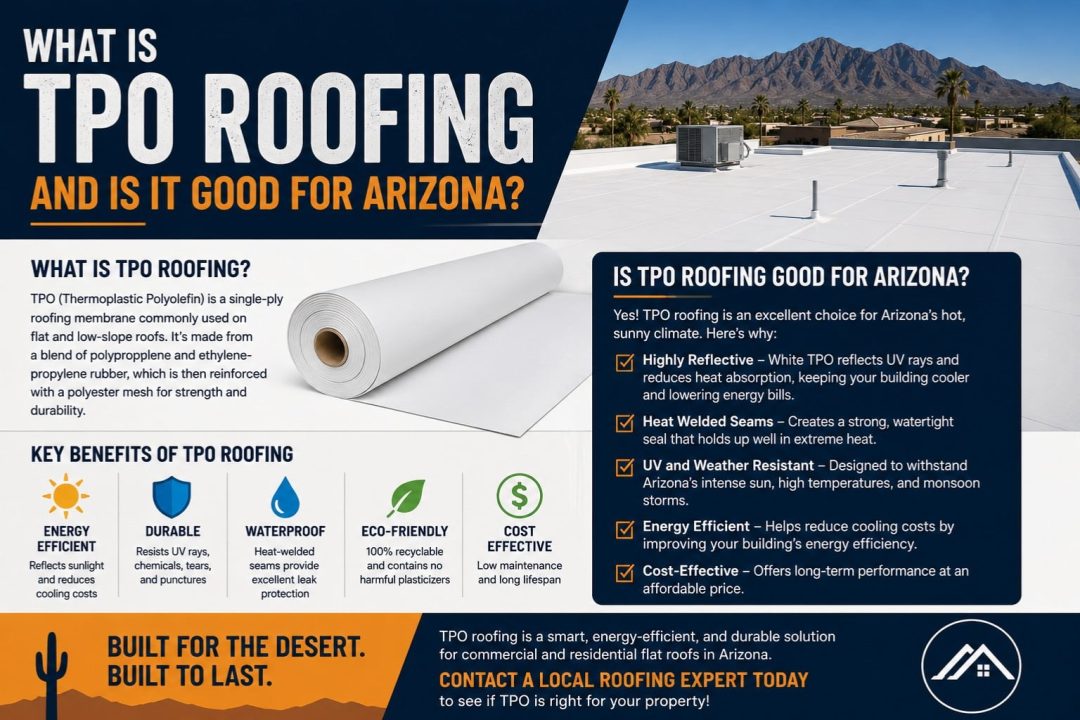
If you own a commercial property, a home with a flat patio cover or addition, or a modern design home with a low-slope roof section in Arizona, you have probably heard TPO mentioned as a roofing option. It comes up frequently — but for most property owners outside the commercial roofing industry, the term raises more questions than it answers. What exactly is TPO roofing? How does it perform in Arizona’s extreme climate? And how does it compare to the spray foam systems that have long been popular across the Phoenix metro?
This guide answers all of those questions directly — covering what TPO is made of, how it is installed, what makes it particularly well-suited or poorly suited to Arizona’s conditions, what it costs, and how it compares to the other flat roofing options available to Arizona property owners.
What Is TPO Roofing?
TPO stands for Thermoplastic Polyolefin. It is a single-ply roofing membrane — a single layer of flexible synthetic material that serves as the primary waterproofing barrier on flat and low-slope roofing applications. TPO is manufactured from a blend of polypropylene and ethylene-propylene rubber, combined with reinforcing fibers for tensile strength.
TPO was introduced to the North American roofing market in the early 1990s as manufacturers sought to develop a membrane that combined the best performance characteristics of two earlier technologies — PVC (polyvinyl chloride) roofing, which offered excellent chemical resistance and weldable seams, and EPDM (ethylene propylene diene monomer) roofing, which offered flexibility and longevity — while eliminating their respective drawbacks. PVC was expensive and contained plasticizers that could migrate out of the membrane over time, causing brittleness. EPDM was typically black, meaning it absorbed rather than reflected heat, and its seams required adhesive or tape rather than heat welding.
TPO addressed both issues. It is typically manufactured in white or light gray, giving it the reflective properties that make it a natural fit for hot climates like Arizona. And its seams are heat-welded — fused together using a specialized hot-air welding tool that creates a bond often stronger than the membrane itself, without relying on adhesives or tapes that can degrade over time.
Today TPO is one of the most widely installed commercial roofing membranes in the United States, and its use on residential flat sections — patio covers, additions, Arizona rooms, and modern design homes with flat roof sections — has grown significantly across the Phoenix metro in recent years.
How TPO Roofing Is Installed
Understanding TPO installation helps property owners evaluate contractor proposals, identify potential quality differences, and understand why installation quality matters as much as material selection in Arizona’s extreme conditions.
Substrate and Insulation Preparation
TPO is installed over a prepared roof deck — typically a concrete deck, metal deck, or wood sheathing. Before the membrane goes down, insulation is installed to provide thermal performance and a smooth, flat base. Polyisocyanurate (polyiso) is the most common insulation used under TPO in Arizona commercial applications because it delivers excellent R-value per inch of thickness — important when Arizona’s energy codes require minimum insulation values for commercial low-slope roofs. The insulation layer is either mechanically fastened or adhered to the deck depending on the attachment method being used for the overall system.
Membrane Attachment Methods
TPO membrane can be attached to the roof assembly in three primary ways, each with different performance and cost implications:
Mechanically fastened: The membrane is fastened to the deck through the insulation using screws and plates at regular intervals, with the fasteners covered by the overlapping membrane of the next sheet. This is the most common attachment method for large commercial roofs because it is the most cost-effective and fastest to install. The limitation is that mechanical fasteners create stress points in the membrane under wind uplift loading.
Fully adhered: The membrane is bonded to the insulation layer with adhesive across its entire surface. This eliminates stress points at fastener locations, reduces membrane flutter under wind loading, and generally produces a higher-performing system — but requires more materials and labor. Fully adhered systems are often specified for Arizona commercial properties with high wind exposure or where membrane aesthetics and longevity are priority considerations.
Ballasted: The membrane is loose-laid over the insulation and held in place with ballast — typically river-washed stone or concrete pavers. Ballasted TPO systems are uncommon in Arizona because ballast adds significant dead load to the roof structure, and the additional weight must be accounted for in the structural design.
Heat-Welded Seams
The defining installation step for TPO — and the one that most affects long-term performance — is seam welding. Adjacent membrane sheets are overlapped by a specified width and fused together using a hot-air welding machine that heats both surfaces simultaneously until they melt together, forming a continuous monolithic bond. Properly executed TPO seams are stronger than the membrane itself — they do not rely on adhesive, tape, or sealant, and they do not degrade from UV exposure or thermal cycling the way adhesive-based seams do.
Improperly welded seams are the most common cause of TPO roof failure. A seam that was welded at the wrong temperature, speed, or overlap width may look correct from the surface but contain voids, insufficient bonding depth, or edge separations that become active leak points under the next heavy rain. In Arizona, where monsoon storms deliver sudden intense downpours and high winds simultaneously, a compromised seam is found by the storm. This is why installation quality — specifically the experience and equipment of the crew performing the seam welding — matters enormously with TPO roofing.
Flashing and Detail Work
Every penetration, edge, drain, HVAC curb, parapet wall, and roofline transition requires careful flashing detail. These are the areas where single-ply membrane roofing most commonly fails, not in the field of the membrane itself. Pre-formed TPO flashing pieces are available for many standard configurations, but complex transitions require field fabrication and careful installation by experienced crews. In Arizona, where HVAC units are ubiquitous on commercial rooftops and residential flat sections frequently have multiple penetrations, detail work quality is a critical performance factor.
How TPO Performs in Arizona’s Climate
This is the central question for Arizona property owners — and the honest answer is that TPO is one of the strongest-performing single-ply flat roofing options for Arizona’s specific climate challenges, with some important qualifications.
Solar Reflectance: TPO’s Greatest Arizona Advantage
Arizona’s primary roofing challenge is heat. The Phoenix metro regularly exceeds 110°F in summer, and dark roofing surfaces can reach 150°F to 170°F on peak heat days. This surface heat transfers into the building below, increasing cooling loads and energy costs substantially.
Standard white TPO membrane has a solar reflectance value of approximately 0.72 to 0.80 — meaning it reflects 72% to 80% of incoming solar radiation rather than absorbing it. This dramatically reduces roof surface temperatures compared to dark roofing materials. Studies have shown that white TPO membranes can reduce roof surface temperatures by 50°F to 60°F compared to dark alternatives in direct sun exposure. In Arizona’s climate, this temperature reduction translates directly to reduced HVAC demand — commonly cited as a 10% to 20% reduction in cooling energy costs for commercial properties.
For Arizona commercial property owners managing buildings with significant air conditioning costs, this energy performance is not a marginal benefit — it is a meaningful operational cost reduction that affects the financial return of every year the roof is in service.
Heat-Welded Seam Durability Under Arizona’s Thermal Cycling
Arizona’s daily temperature swings — from over 100°F during the day to significantly cooler at night — create constant thermal expansion and contraction in roofing materials. Adhesive-based roofing systems are particularly vulnerable to this cycling because adhesives degrade from repeated flexing and from Arizona’s UV intensity. EPDM seams adhered with tape or liquid adhesive are among the most failure-prone details in Arizona’s climate for exactly this reason.
TPO’s heat-welded seams handle thermal cycling significantly better than adhesive alternatives. The welded seam is a mechanical fusion of the membrane material — not an adhesive bond that can fatigue and release. This gives properly welded TPO a meaningful seam durability advantage in Arizona’s extreme temperature swing environment compared to other flat roofing systems that rely on adhesives at their seam connections.
UV Resistance at the Surface Level
UV radiation is the other major Arizona roofing stressor, and it affects TPO differently than it affects older flat roofing technologies. Modern TPO formulations are engineered with UV stabilizers built into the membrane composition. The white surface reflects the UV load rather than absorbing it — reducing the UV degradation that breaks down darker membrane materials over time.
However, an important qualifier applies here: early TPO formulations from the 1990s and early 2000s had documented problems with premature UV degradation and seam failures in hot, high-UV climates. The material has improved substantially since then, and modern TPO from reputable manufacturers is meaningfully more durable than first-generation products. This history is the reason why TPO product quality varies significantly between manufacturers — not all TPO products are equal in terms of UV resistance and longevity, and product specification matters in Arizona more than in moderate climates.
Monsoon Storm Performance
Arizona’s monsoon season — July through September — delivers sudden high-wind storms with intense downpours. TPO’s performance during monsoon events depends primarily on two factors: seam quality and drainage design.
Well-welded TPO seams handle monsoon rain loads effectively — the membrane is highly water-resistant and the seamless nature of a properly welded system eliminates the gaps and adhesive failures that cause many flat roof leaks during storm events. However, flat roofs that drain poorly — with inadequate drain size, clogged drains, or insufficient slope toward drains — will pond water after heavy monsoon downpours. Standing water accelerates membrane wear and can overwhelm any flat roofing system given sufficient depth and duration. Proper drain sizing and regular pre-monsoon drain clearing are maintenance obligations for any Arizona flat roof, including TPO.
TPO vs. Spray Polyurethane Foam: How They Compare in Arizona
For Arizona property owners with flat or low-slope roof sections, the most common comparison is TPO versus spray polyurethane foam (SPF). Both are widely used and perform well in Arizona’s climate — but they have meaningful differences. Our full comparison guide on asphalt versus foam roof replacement covers the broader material comparison, and the guide on flat roofs in Arizona covers the full flat roofing picture.
Seams vs. seamless: TPO has heat-welded seams at every sheet overlap — these are strong when properly executed but remain potential failure points if installation quality is inadequate. Spray foam is applied as a continuous seamless coating with no seams — eliminating the seam failure risk entirely. For complex roof configurations with many penetrations and transitions, foam’s seamless nature is a meaningful advantage.
Insulation value: Spray foam provides both waterproofing and insulation in a single application — the foam itself has excellent R-value per inch. TPO is a waterproofing membrane only — insulation is a separate component added beneath it. For maximizing thermal performance in a thin assembly, foam has an inherent advantage.
Maintenance requirements: Foam roofing requires recoating of the protective elastomeric coating every five to seven years to maintain UV protection for the foam below. Without recoating, UV exposure degrades the foam surface. TPO does not require recoating — the membrane itself provides the UV resistance. However, TPO does require regular inspection and maintenance of seams, flashing details, and drain areas.
Cost: For smaller residential flat sections — patio covers, Arizona rooms — foam installation is often more cost-effective than TPO because the seamless application requires less labor for irregular shapes and penetrations. For larger commercial flat roofs, TPO is typically more economical per square foot at installation while delivering comparable long-term performance.
Repairability: TPO repairs are straightforward — damaged sections of membrane can be patched with new material and heat-welded. Foam repairs require matching the existing coating system and proper surface preparation. Both are repairable by qualified contractors.
TPO Membrane Thickness: What Arizona Property Owners Should Specify
TPO membrane is available in three standard thicknesses — 45 mil, 60 mil, and 80 mil — and the specification decision matters significantly in Arizona’s climate.
45 mil: The thinnest and most affordable option. Suitable for low-traffic flat sections with minimal HVAC access requirements. Less puncture-resistant and typically carries shorter manufacturer warranty terms — often 10 to 15 years. Not recommended as a first choice for Arizona commercial applications given the UV and thermal cycling exposure.
60 mil: The industry standard for most commercial and residential flat roofing applications. Provides a good balance of durability, cost, and performance. Most manufacturers require at least 60 mil for their 20-year warranty terms to apply. For Arizona properties with regular HVAC maintenance access to the roof, 60 mil is the minimum recommended specification.
80 mil: The premium option, providing maximum puncture resistance, superior seam strength, and the best performance under Arizona’s extreme thermal cycling. Manufacturers typically offer 25 to 30-year warranty terms on 80 mil systems when properly installed. For Arizona commercial roofs with high foot traffic for HVAC maintenance, or for property owners who want the longest possible service life, 80 mil is the appropriate specification.
A critical note from roofing experts: membrane thickness alone does not determine quality. What matters is the thickness above the scrim — the reinforcing fabric layer within the membrane. An 80 mil membrane with a thin top-ply above the scrim may not outperform a well-manufactured 60 mil product with a thicker working layer. Product specification should include manufacturer, product line, and warranty terms — not just nominal thickness.
What Does TPO Roofing Cost in Arizona?
TPO roofing costs in Arizona are broadly in line with national market rates, adjusted for local labor costs and the additional performance specifications appropriate for desert climate conditions.
| System Type | Installed Cost Per Sqft | Typical Lifespan | Notes |
|---|---|---|---|
| 45 mil TPO — mechanically fastened | $5.50 – $7.00 | 15 – 20 years | Budget option; not recommended for AZ commercial |
| 60 mil TPO — mechanically fastened | $6.50 – $9.00 | 20 – 25 years | Standard commercial specification |
| 60 mil TPO — fully adhered | $8.00 – $11.00 | 20 – 25 years | Higher performance; recommended for wind exposure |
| 80 mil TPO — fully adhered | $10.00 – $14.00 | 25 – 30 years | Premium; high-traffic or long-term investment |
Pricing reflects current Arizona market conditions. Insulation adds $1.50 to $4.00 per sqft depending on type and R-value requirement. Tear-off and disposal of existing roofing adds $1.00 to $3.00 per sqft. Complex roofs with many penetrations, HVAC curbs, and detail work will cost more than simple open field applications. Always request a written itemized estimate before work begins.
For context on energy savings: a white TPO system on a 10,000 sqft Arizona commercial building that reduces cooling costs by 15% on an $18,000 annual energy bill saves $2,700 per year — recovering the premium cost of a higher-specification system in relatively short order while delivering 25 or more years of service.
When TPO Makes Sense — And When It Does Not
TPO is an excellent choice for Arizona property owners in the following situations:
- Commercial flat roofs of any size where energy performance is a priority
- Flat roof sections on residential properties where the budget does not justify foam’s premium
- Roofs where regular foot traffic for HVAC maintenance makes puncture resistance important — specify 60 or 80 mil
- Re-roofing projects where removing existing roofing is required and a new complete system is being installed
- Properties where the building owner plans long-term ownership and values manufacturer warranty coverage
TPO may not be the optimal choice in the following situations:
- Very small, irregular flat sections with many penetrations and transitions — foam’s seamless application is often more practical and cost-effective at small scale
- Properties where the existing foam roof is in good condition and only recoating is needed — recoating is more cost-effective than tear-off and replacement with TPO
- Situations where installation quality cannot be verified — a poorly welded TPO system will perform worse than a well-maintained foam system
TPO Roofing in Arizona? Tip Top Roofing Service Installs It Right
Tip Top Roofing Service is a GAF-certified, BBB-accredited roofing contractor with over 10 years of experience installing and servicing TPO, foam, and all major flat roofing systems across the Phoenix metro and Arizona. We understand the specific performance requirements that Arizona’s climate places on every flat roofing specification — from membrane selection and thickness to seam welding quality and drain management.
What you get when you work with us:
- Free flat roof inspection and written estimate — no pressure, no obligation
- Licensed and insured in Arizona: ROC License #355034
- Expert guidance on TPO vs. foam vs. other flat roofing options for your specific property
- Properly specified membrane thickness for Arizona’s climate conditions
- Free estimates for new roof installations
- 0% interest financing over 12 months — learn more about financing a new roof in Arizona
- Up to 30-year material warranties on qualifying systems
- Commercial roofing experience across Scottsdale, Phoenix, and the Phoenix metro
- 130+ five-star Google reviews from verified Arizona property owners
We serve Chandler, Mesa, Gilbert, Peoria, Surprise, Goodyear, Avondale, Scottsdale, Phoenix, Tempe, and 40+ Arizona cities.
Call (480) 877-1643 or email info@tiptoproofingservice.com to schedule your free flat roof inspection today.
Frequently Asked Questions: TPO Roofing in Arizona
What does TPO stand for in roofing?
TPO stands for Thermoplastic Polyolefin. It is a single-ply roofing membrane made from a blend of polypropylene and ethylene-propylene rubber with reinforcing fibers for tensile strength. TPO is one of the most widely installed flat roofing membranes in the United States and is particularly well-suited for hot climates like Arizona due to its white reflective surface and heat-welded seam technology.
How long does a TPO roof last in Arizona?
A properly specified and correctly installed TPO roof in Arizona can last 20 to 30 years depending on membrane thickness and product quality. A 60 mil system from a reputable manufacturer typically carries a 20-year warranty and realistically delivers 20 to 25 years of service in Arizona’s climate when maintained properly. An 80 mil system can reach 25 to 30 years. The critical factors affecting lifespan in Arizona are seam weld quality, product specification from a reputable manufacturer, and regular maintenance of drains and penetration details. For a full breakdown of how long different roofing materials last in Arizona, see our dedicated guide.
Is TPO or spray foam better for Arizona flat roofs?
Both perform well in Arizona’s climate — the best choice depends on your specific property and priorities. Spray foam is seamless — eliminating seam failure risk — and provides integrated insulation value, making it particularly well-suited for small, irregular flat sections with many penetrations. TPO is more cost-effective on large commercial flat roofs, requires no periodic recoating, and carries manufacturer warranty coverage with clear term documentation. For large commercial flat roofs, TPO is typically the stronger specification. For small residential flat sections and re-roofing over existing foam systems, foam is often more practical. Our foam roof coating guide covers the foam option in full detail.
What TPO thickness should I specify for an Arizona commercial roof?
For Arizona commercial applications, 60 mil is the minimum recommended specification — it is the industry standard that most manufacturers require for their 20-year warranty terms to apply, and it provides adequate performance for Arizona’s thermal cycling and UV exposure. For roofs with regular HVAC maintenance foot traffic, high wind exposure, or where the property owner wants maximum service life, 80 mil is the appropriate specification and supports manufacturer warranty terms up to 25 to 30 years. The 45 mil option is generally not recommended for Arizona commercial applications given the climate demands.
How do I maintain a TPO roof in Arizona?
TPO requires two maintenance priorities in Arizona. First, pre-monsoon drain cleaning — clearing all roof drains, scuppers, and drainage pathways of the fine silica and debris that Arizona’s frequent haboobs deposit on flat roofs throughout the year. Blocked drains cause ponding water that accelerates membrane wear and overwhelms any flat roofing system during intense monsoon downpours. Second, annual professional inspection — checking seam integrity, flashing conditions at all penetrations and HVAC curbs, and the condition of the membrane field for any impact damage or UV degradation. Our annual roof inspection guide covers what a thorough flat roof inspection should include.
Does TPO roofing qualify for any energy credits in Arizona?
Standard TPO membrane roofing does not currently qualify for the federal Energy Efficient Home Improvement Credit (Section 25C). However, TPO’s high solar reflectance typically meets ENERGY STAR and Cool Roof Rating Council (CRRC) certification standards, which are required for compliance with Arizona energy codes on commercial low-slope roofs in Phoenix, Scottsdale, and other municipalities with cool roof requirements. The energy cost savings from TPO’s reflective performance — typically 10% to 20% reduction in cooling costs — represent a direct financial benefit even without a formal tax credit. For a full picture of roofing tax deductions and credits in Arizona, see our complete tax guide.
Tip Top Roofing Service | (480) 877-1643 | info@tiptoproofingservice.com | tiptoproofingservice.com | 6830 E 5th Ave #205, Scottsdale, AZ 85251 | ROC License #355034