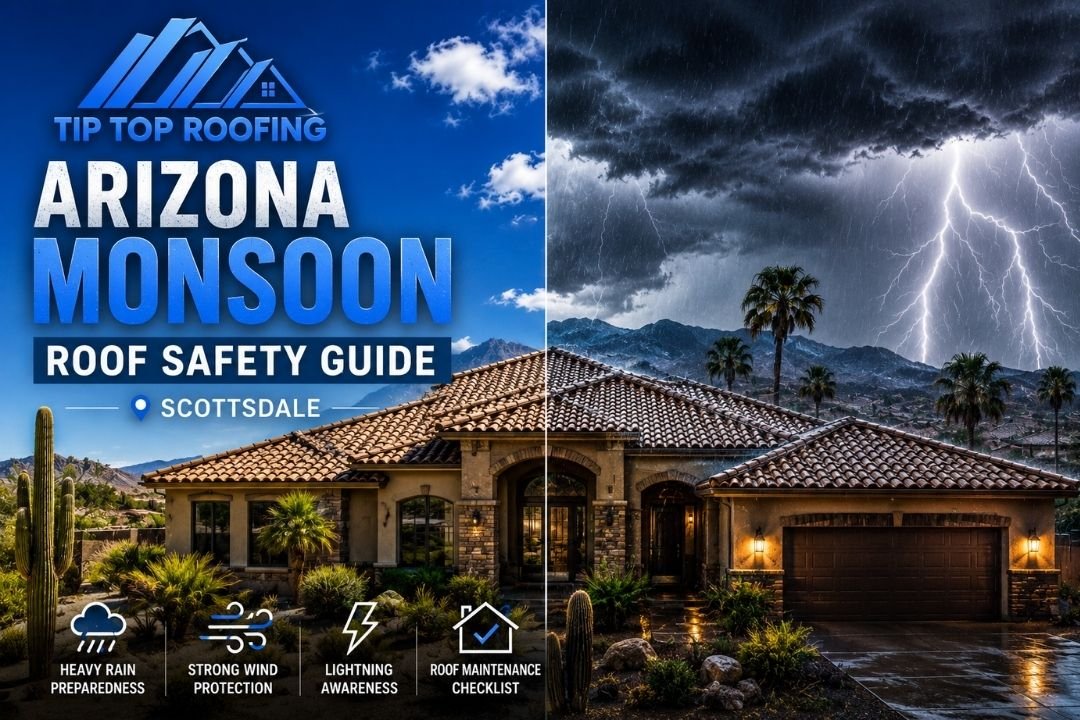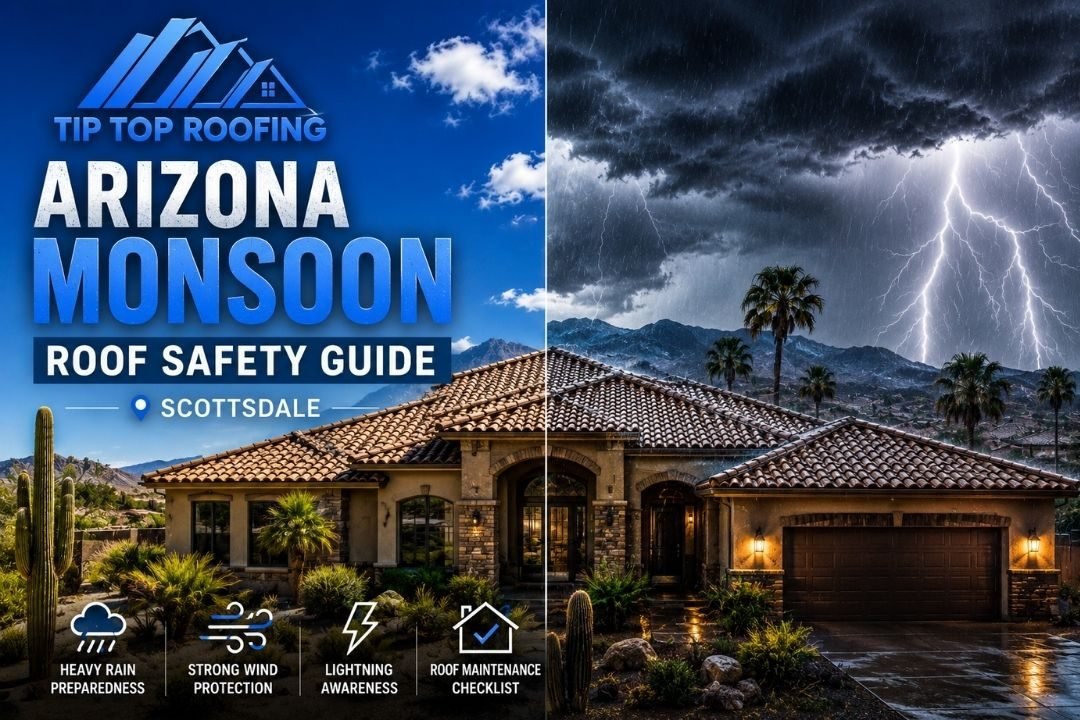
Arizona’s monsoon season runs officially from June 15 through September 30 — and for Scottsdale homeowners, it represents the most consequential period on the roofing calendar. The National Weather Service Phoenix Office records monsoon storms delivering winds that regularly exceed 60 mph, sudden intense downpours, hail, and haboobs that drive abrasive silica particles across the Valley at high velocity. In a single recent season, Maricopa County recorded more than 1,400 storm-damage insurance claims, with roof incidents accounting for over 60 percent of them.
What most Scottsdale homeowners do not fully appreciate is that the monsoon itself rarely creates damage from scratch. It reveals and accelerates damage that months of extreme summer heat already started. The Arizona Registrar of Contractors lists improper maintenance as the leading cause of post-monsoon roofing complaints statewide — meaning the majority of costly post-storm repairs were preventable with timely pre-monsoon attention from a licensed roofing company in Scottsdale AZ.
This guide covers everything you need to know about Arizona roof safety before storm season: how extreme heat weakens roofing systems before the first storm arrives, the warning signs that demand immediate attention, what a proper monsoon roof inspection Scottsdale homeowners should schedule every spring, how to document your roof for insurance purposes, and how to decide whether repair or replacement is the right call before storms begin.
How Arizona’s Extreme Heat Damages Your Roof Before Monsoon Arrives
Storm damage does not begin with the storm. It begins in April, May, and June — months of relentless UV radiation and triple-digit temperatures that degrade roofing materials daily before a single monsoon cloud forms on the horizon. By the time the first storm arrives in July, a poorly maintained Scottsdale roof has already been weakened in ways that the monsoon will rapidly expose.
What Happens to Shingles at 160°F Rooftop Temperatures
Scottsdale’s summer air temperatures regularly exceed 110°F. On dark roofing surfaces, that translates to rooftop temperatures of 150°F to 165°F or more during peak summer afternoons. At these temperatures, the asphalt in shingles softens and the adhesive strips that bond shingle tabs in place lose their tack. Shingles that have already experienced several Arizona summers begin to stiffen, warp at their edges, and develop stress fractures in the asphalt matrix — changes invisible from the ground but creating structural vulnerability across the entire shingle surface.
The practical consequence: a shingle that has spent five or more Arizona summers at rooftop temperatures above 150°F has lost a meaningful portion of its original flexibility and impact resistance. When monsoon hail strikes that hardened surface, it bruises or cracks material that would have survived the same impact earlier in its service life. Heat does not just age shingles — it pre-damages them in ways that make storm events far more destructive than they would be on a well-maintained roof.
How UV Exposure Dries Out Asphalt Oils Over Time
Asphalt shingles rely on petroleum-based oils within their matrix for flexibility and weather resistance. Arizona’s intense UV radiation breaks down these oils through a process called photo-oxidation. As the oils volatilize and evaporate, the asphalt becomes increasingly brittle, loses its ability to shed water effectively, and develops hairline surface cracking that eventually opens into visible fractures.
This is why roofing material manufacturers’ lifespan ratings — based on moderate climate performance — significantly overstate realistic service life in Scottsdale. A 25-year architectural shingle may begin showing serious UV-related degradation at 15 to 18 years in Arizona’s sun. Understanding why Arizona roofs fail faster than homeowners expect is the first step in protecting yours before monsoon season puts that degraded surface to the test.
Why Thermal Expansion Weakens Flashing and Sealants
Every day in a Scottsdale summer, roofing materials expand in the afternoon heat and contract at night — a daily temperature cycle of 30°F or more. Metal flashing, roofing sealants, and adhesive connections between roofing components are all subject to this mechanical stress. Over a full summer of repeated cycles, sealant around vents, pipes, skylights, and chimney flashings develops micro-cracks that eventually become gaps. These failures are typically invisible from the ground — often smaller than a pencil width — but they are large enough to admit wind-driven monsoon rain at the angles and velocities that Arizona storms deliver. Flashing that holds through a mild spring rain can fail completely when a July microburst drives rain horizontally across the roofline at 60 mph.
5 Warning Signs Your Scottsdale Roof Needs Attention Before Storm Season
A ground-level assessment before monsoon season — ideally in April or May — can identify the most visible warning signs that require professional attention. These five indicators are the most reliable signals that pre-monsoon Scottsdale roof repair is needed before the first storm arrives.
Cracked, Curling, or Missing Shingles
Shingles that are cracking across their surface, curling at their edges or corners, or missing entirely from the roof field are clear indicators that they have reached or exceeded their reliable service life in Arizona’s climate. Curling takes two forms: cupping, where shingle edges turn upward, and clawing, where the middle of the shingle rises while the edges stay flat. Both indicate advanced UV and thermal degradation. A single monsoon storm with 60+ mph wind gusts will tear curled shingles from the roof entirely. A cracked shingle is already an active water entry point waiting for the next rain.
Granule Loss in Gutters
Check your gutters during a dry period before monsoon season. A significant accumulation of dark, sand-like granules in gutters and at the base of downspouts is one of the most reliable pre-monsoon warning signs for Scottsdale homeowners with asphalt shingle roofs. Granules are the protective coating that shields shingle asphalt from UV radiation. Their loss is not cosmetic — it is the removal of the primary UV barrier, after which asphalt degradation accelerates dramatically. Heavy granule accumulation in gutters signals that widespread shingle breakdown has already occurred across the roof areas draining to those gutters.
Daylight Visible Through Attic Boards
On a bright day, access your attic and look upward at the underside of the roof deck. Any point of light visible through the boards or sheathing indicates a gap, crack, or hole in both the roofing material above and the structural sheathing beneath it. If light can get through, so can water — and wind-driven monsoon rain will find every such opening. Daylight in your attic is an urgent pre-monsoon repair situation, not something to monitor through storm season.
Water Stains on Interior Ceilings
Existing water stains on interior ceilings — even ones that appear dry and stable — indicate that your roof has already been breached. A stain that appeared months ago and has not grown may tempt homeowners to assume the issue resolved itself. It has not. The entry point that produced that stain is still present and will be found by the first significant monsoon downpour. Any ceiling stain warrants a professional inspection to locate and address the source before storm season creates active interior water damage. Our guide on how to find a roof leak from inside your Arizona home explains the tracing process in full detail.
Flashing Gaps Around Chimneys and Vents
From the ground with binoculars, or from the top rungs of a ladder at the eave, look specifically at the flashing around every chimney, vent pipe, skylight, and HVAC penetration on your roof. Flashing that has pulled away from its surface, sealant that has cracked and separated, or visible gaps at flashing edges are active vulnerabilities that wind-driven monsoon rain will exploit. In Scottsdale, where tile is the dominant roofing material and homes frequently have multiple HVAC units, skylights, and chimney features, flashing failures are among the most common causes of monsoon-season leak calls to every roofing company in Scottsdale AZ.
What a Proper Pre-Monsoon Roof Inspection Should Include
A pre-monsoon roof inspection is not a brief visual scan from the driveway. A professional inspection that provides meaningful Arizona roof safety requires physical access to the roof surface and a systematic assessment of every component. Here is exactly what a proper pre-monsoon roof checklist Arizona homeowners should expect when a licensed contractor completes a thorough inspection.
Shingle Condition Assessment
A licensed inspector physically accesses the roof surface and assesses the condition of every shingle or tile section. For asphalt shingle roofs this includes checking for granule loss, surface cracking, tab lifting, cupping, clawing, and displaced or missing sections. For tile roofs — the most common roofing material in Scottsdale — it includes checking for cracked, shifted, or loose tiles across the field, with particular attention to windward exposures that bear the brunt of monsoon wind loading. Any tile that has lost its bond or shifted from its position is a pre-monsoon repair item.
Flashing and Sealant Check
Every penetration point on the roof — every pipe, vent, chimney, skylight, HVAC curb, and roofline transition — must be physically assessed. The inspector checks that flashing is properly bonded, that sealant at all penetration edges is intact and flexible rather than cracked, and that ridge cap mortar is sound. For Scottsdale tile roofs, valley flashing — the metal channels where two roof planes meet — is assessed for corrosion, separation, and debris accumulation that can block drainage during heavy monsoon downpours.
Drainage and Gutter Evaluation
Monsoon storms deliver intense, sudden precipitation that challenges every drainage system. The pre-monsoon inspection should confirm that all gutters are securely attached, free of significant debris, and sloped correctly toward downspouts. Downspouts should be confirmed to discharge water away from the foundation. Flat roof sections — common on Scottsdale patios, Arizona rooms, and additions — must have clear, functional drains capable of handling the volume of a monsoon downpour without allowing ponding. Even a short period of standing water on a flat roof adds significant structural load and accelerates membrane wear.
Attic Ventilation Review
Proper attic ventilation is both a comfort and a roofing longevity issue in Arizona. Attics that are inadequately ventilated reach temperatures of 150°F or more during Scottsdale summers — temperatures that bake the underside of the roof deck, dry out the adhesives holding roofing components in place, and dramatically shorten the life of shingles and underlayment from below. A pre-monsoon inspection should confirm that ridge vents, soffit vents, and any powered ventilation equipment are functional, unobstructed, and providing adequate air movement to keep attic temperatures at manageable levels throughout the summer and monsoon season.
Written Condition Report With Photos
A professional pre-monsoon inspection should always conclude with a written report documenting the inspector’s findings — with photographs of every issue identified and every area assessed. This report serves two purposes simultaneously: it tells you exactly what needs attention before storm season and establishes a dated, documented baseline of your roof’s condition before monsoon storms arrive. That documentation is one of the most valuable assets you can have if you later need to file an insurance claim. Our detailed guide on what a professional roof inspection should include covers the full scope in detail.
How to Document Your Roof’s Condition for Insurance Claims
Insurance adjusters evaluate every Arizona roof claim on one central question: was this damage caused by a sudden covered storm event or by pre-existing wear and deferred maintenance? The homeowners who answer that question successfully — and receive full, fair claim settlements — are the ones who documented their roof’s condition before the storm arrived.
Why Pre-Storm Documentation Matters
Arizona homeowner’s insurance policies cover sudden, accidental storm damage. They explicitly exclude damage from gradual deterioration, aging, and lack of maintenance. In practice, this creates a gray zone that adjusters navigate every monsoon season — and the gray zone almost always resolves in favor of whoever has better documentation. A homeowner who had a professional inspection in May, received a written report confirming their roof was in sound condition at that time, and then files a claim in August after a documented storm event has a fundamentally stronger claim position than one who cannot demonstrate the roof’s pre-storm condition at all.
What Photos to Take and When
Begin documenting your roof before monsoon season — not after a storm. Photograph the full roofline from every angle around the property perimeter. Photograph gutters, downspouts, HVAC units, vents, skylights, and any other visible roof features. Photograph the interior — attic decking, any existing ceiling stains, and insulation condition. All photos should be timestamped, which most smartphone cameras do automatically. After any significant storm event, repeat the exterior perimeter walk and document any new damage immediately — before any temporary repairs are made and before significant time passes from the storm event. Photographic timestamps that align with documented storm events are among the most compelling evidence in any roof insurance claim.
How to Work With Your Adjuster After Monsoon Damage
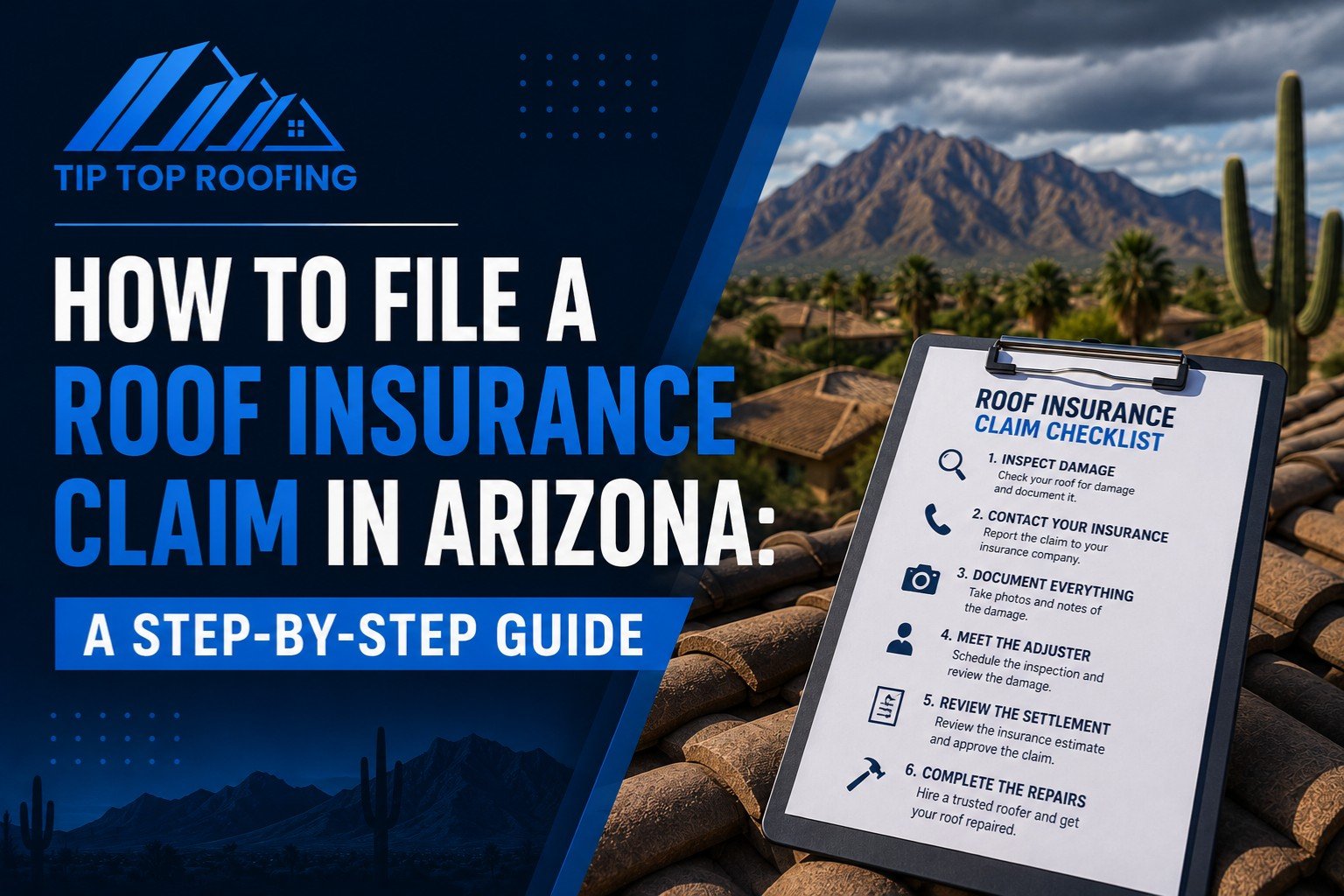
Request that your licensed roofing contractor be present during the adjuster’s inspection. This is your right as a homeowner, and it materially improves claim outcomes. A contractor present during the adjuster visit can identify specific storm damage the adjuster might otherwise miss or attribute to pre-existing wear, explain technical distinctions in terms the adjuster understands, and ensure all covered damage is included in the report before it is finalized. Share your pre-storm inspection report with the adjuster — it establishes your roof’s baseline condition and directly supports the argument that damage found after the storm was not pre-existing. For a complete step-by-step guide to filing a roof insurance claim in Arizona, our dedicated guide covers every stage of the process.
Roof Repair vs. Full Replacement — How to Decide Before Monsoon Season
One of the most important decisions Scottsdale homeowners face before monsoon season is whether to repair identified issues or invest in a full roof replacement. Making the right call before storm season matters — entering monsoon season with a patched roof that needed replacement is expensive twice: once for the patches and again when the system fails under storm conditions.
When a Repair Is Enough
Scottsdale roof repair makes clear sense when the damage or deterioration is genuinely isolated — a section of failed flashing around a specific vent, a small number of cracked tiles in one area, a localized section of shingle lift after a wind event. When the surrounding roofing system is in sound condition, the underlayment is intact, and the roof is less than 15 years old, targeted repairs address the specific vulnerability without requiring replacement of components that still have meaningful service life remaining. The key qualifier is that the roof’s broader condition must be sound — an isolated repair on a system that is failing across multiple areas is not a durable solution.
When Replacement Is the Smarter Investment
Replacement becomes the stronger investment when the roof is approaching or past its realistic Arizona service life, when damage or deterioration appears across multiple sections, when underlayment has failed in more than one location, or when the cumulative cost of targeted repairs approaches a meaningful fraction of a full replacement. In Scottsdale, where tile roofs aging past 20 years frequently have widespread underlayment failure beneath intact-looking tile surfaces, entering monsoon season with a patchwork of repairs on a system that needs replacement is a false economy. One significant storm event can turn a $3,000 multi-area repair into a $15,000 emergency replacement with interior water damage included.
How Age, Material, and Damage Extent Affect the Decision
Three factors drive the repair-versus-replacement framework in every Scottsdale roofing assessment. Age — an asphalt shingle roof over 15 years old in Arizona has consumed most of its reliable service life regardless of how it looks from the ground. Material — tile roofs can last 50 or more years but require underlayment replacement every 20 to 30 years; a 25-year-old tile roof may look perfect while the waterproofing membrane beneath it has completely failed. Damage extent — isolated failures call for repair; failures across more than one-third of the roof surface call for replacement. A licensed contractor who physically inspects the full roof should always present both options with honest cost projections for each path before any work is authorized.
Frequently Asked Questions
How much does a roof inspection cost in Scottsdale?
Tip Top Roofing Service offers free pre-monsoon roof inspections with a written condition report and photographs for Scottsdale homeowners — no charge, no obligation. Some contractors charge $150 to $300 for a professional inspection, which is reasonable for the scope of a thorough assessment. The cost of a professional pre-monsoon inspection is always a fraction of the cost of a single monsoon-season repair that an inspection would have caught in time to prevent.
How long does a monsoon roof repair take?
Most pre-monsoon Scottsdale roof repairs are completed in a single day. Minor repairs — replacing individual tiles, resealing flashing penetrations, clearing and repairing drainage — typically take two to four hours of professional time. More involved repairs involving multiple sections, underlayment replacement in affected areas, or re-mortaring ridge cap runs may take one to two days. Emergency post-storm repairs during active monsoon season can often be completed same-day or next-day depending on the scope and contractor availability. Tip Top Roofing Service offers same-day and next-day response for urgent storm damage across Scottsdale and the Phoenix metro.
Does homeowner’s insurance cover monsoon roof damage in Arizona?
Arizona homeowner’s insurance policies typically cover sudden storm damage from covered monsoon perils — high winds, hail, and falling debris. They do not cover damage from gradual wear, aging, or deferred maintenance. An important Arizona-specific rule: state law prohibits insurers from applying hurricane deductibles to monsoon damage claims — your standard deductible applies. The distinction between covered storm damage and excluded wear is where most Arizona roof claim disputes arise, which is why pre-storm documentation and having a licensed contractor present during the adjuster’s inspection are so important for claim outcomes.
How do I find a licensed roofer in Scottsdale?
All Arizona roofing contractors are required to hold an active license through the Arizona Registrar of Contractors (AZ ROC). Verify any contractor before signing anything at azroc.my.site.com — search by company name or license number and confirm the license is current and free of disciplinary actions. Look for a contractor with verifiable local Scottsdale experience, BBB accreditation, documented Google reviews from identified Scottsdale-area customers, and the ability to provide written estimates and warranty documentation. Tip Top Roofing Service holds Arizona ROC License #355034 and is GAF-certified and BBB-accredited with over 100 five-star Google reviews from verified Phoenix metro homeowners.
What is the best roofing material for Arizona monsoon season?
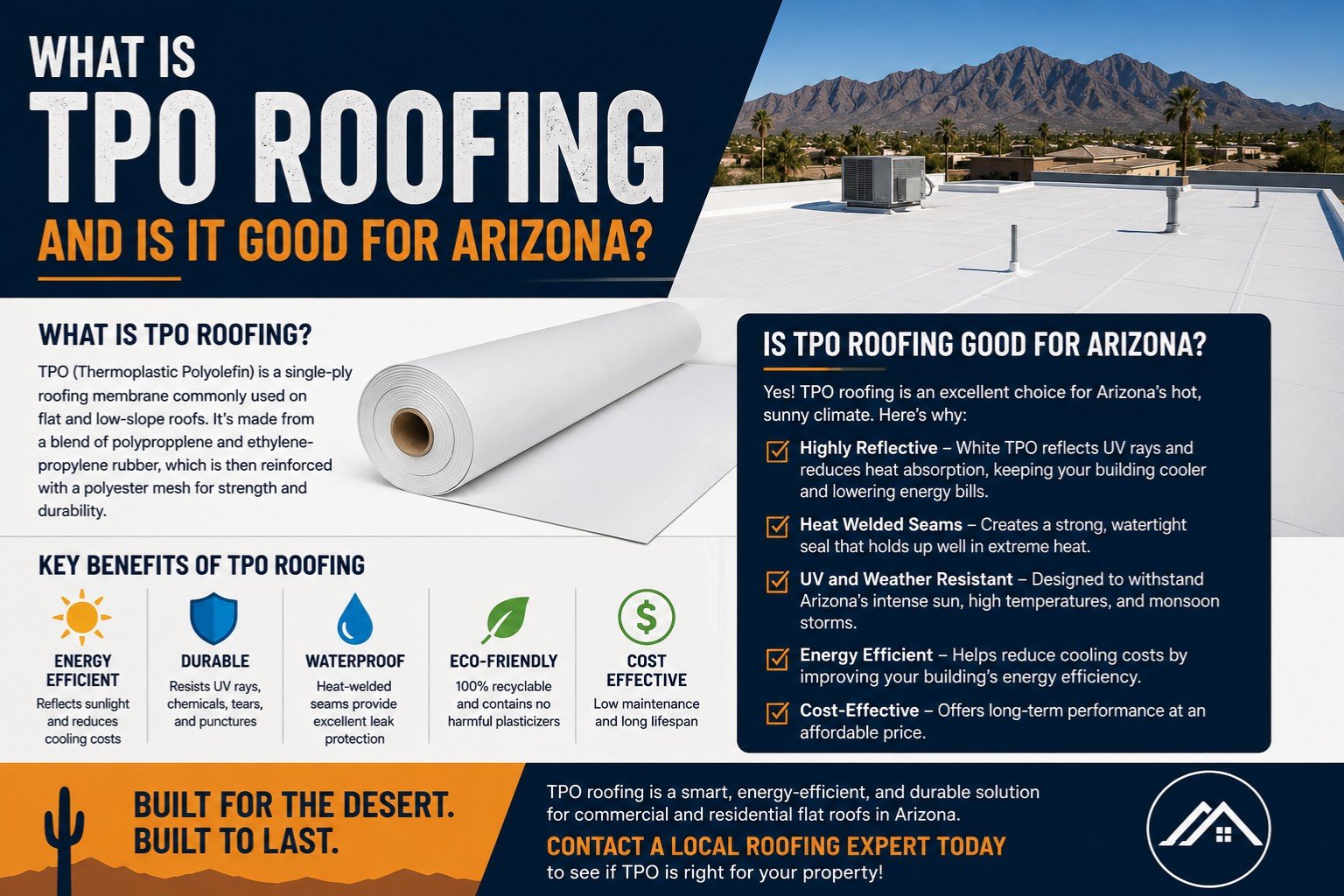
Concrete and clay tile is the strongest performer for Scottsdale’s monsoon climate — it handles UV exposure, extreme heat, and high wind loads better than any other mainstream residential roofing option, and it is appropriately suited to the Southwestern architectural styles dominant across Scottsdale’s established neighborhoods. For flat and low-slope sections common on Scottsdale patios and additions, properly maintained spray polyurethane foam with elastomeric coating is an excellent choice given its seamless construction and superior heat reflectance. Metal roofing performs very well under monsoon conditions with exceptional wind and impact resistance. Modern architectural asphalt shingles rated for high-heat climates are the most affordable option and perform adequately when properly specified — but they have the shortest realistic Arizona service life at 15 to 20 years and the highest vulnerability to the hail events that Scottsdale experiences during storm season.
Is Your Scottsdale Roof Ready for Monsoon Season?
Tip Top Roofing Service is a GAF-certified, BBB-accredited roofing company in Scottsdale AZ with years of experience protecting Phoenix metro homes through every monsoon season. We provide free pre-monsoon roof inspections with written condition reports and photographs — no pressure, no obligation. Schedule yours before storm season begins.
What you get when you work with us:
- Free monsoon roof inspection Scottsdale — written report and photos included
- Licensed and insured in Arizona: ROC License #355034
- Same-day and next-day response for urgent storm damage
- Up to $2,000 off new roof installations
- 0% interest financing over 12 months
- Up to 30-year material warranties on qualifying systems
- Full insurance claim assistance — documentation through settlement
- More than 100 five-star Google reviews from verified Arizona homeowners
📅 Schedule Your Free Monsoon Roof Inspection in Scottsdale
💵 Learn About 0% Financing — Install Now, Pay Later
Tip Top Roofing Service
📞 (480) 877-1643
✉ info@tiptoproofingservice.com
🏠 6830 E 5th Ave #205, Scottsdale, AZ 85251
🌎 tiptoproofingservice.com
ROC License #355034 | GAF Certified | BBB Accredited
We serve Scottsdale, Phoenix, Tempe, Mesa, Chandler, Gilbert, Peoria, Glendale, Surprise, Goodyear, Fountain Hills, Paradise Valley, and 40+ Arizona cities.