Short answer: roof vents are passive openings that let hot air leave the attic, while an attic fan is a powered exhaust that moves air out faster. In most Arizona homes the right answer is not one or the other, but a balanced system with enough intake air, with a fan added only where the roof and intake can support it.
This guide is for homeowners in Phoenix, Scottsdale and nearby cities who are deciding between vent types or hearing a sales pitch for an attic fan. For the basics, start with our roof ventilation guide.
What is the difference between an attic fan and a roof vent?
- Roof vents (passive): box vents, ridge vents and turbine vents. They rely on natural air movement. Air enters low at the soffits or eaves and exits high near the ridge.
- Attic fans (powered): a thermostat or humidistat-controlled fan, or a solar-powered unit, that pushes air out of the attic. They still need air coming in.

Why does intake air matter so much?
Attic ventilation works as a system. The Institute of Building Enclosure and Roof Consultants (IIBEC) notes that intake area should always be equal to or greater than exhaust area, otherwise air may be pulled from the living space through openings such as recessed lights. It also notes that a ridge vent without soffit intake is largely ineffective, and that adding static exhaust vents to a ridge-vented roof can short-circuit airflow. In other words, adding more exhaust without more intake can make things worse.
How much ventilation is enough?
IIBEC describes the 2018 International Residential Code base requirement as 1 square foot of net free ventilating area for every 150 square feet of attic floor, with 1 in 300 allowed only when specific conditions are met, including a balance of high and low vents. IIBEC also notes that powered ventilators rated at 1.0 cfm per square foot of attic floor are generally considered equivalent to a 1:150 ratio under NRCA guidance, and that powered systems still need adequate intake. Local code and roof type control the final number, so have it calculated for your house rather than guessing.
When does an attic fan make sense in Arizona?
- The attic has enough intake at the soffits, but passive exhaust is limited, for example on a hip roof with little ridge.
- A roofer has confirmed there is a heat buildup problem and verified the intake area.
- The fan is thermostat controlled and sealed and flashed correctly at the roof.
When can an attic fan backfire?
- Not enough intake: the fan pulls conditioned air out of the house, which raises cooling costs.
- Mixing systems: a fan running next to ridge vents can pull air from the vents instead of from the eaves.
- Poor installation: a cut hole with weak flashing is a new leak point. Our post on common causes of roof leaks covers where roofs fail.
Which is better for tile, shingle and flat roofs?
- Tile roofs: vents must be integrated with the tile and underlayment. See tile underlayment replacement for why the layer under the tile matters.
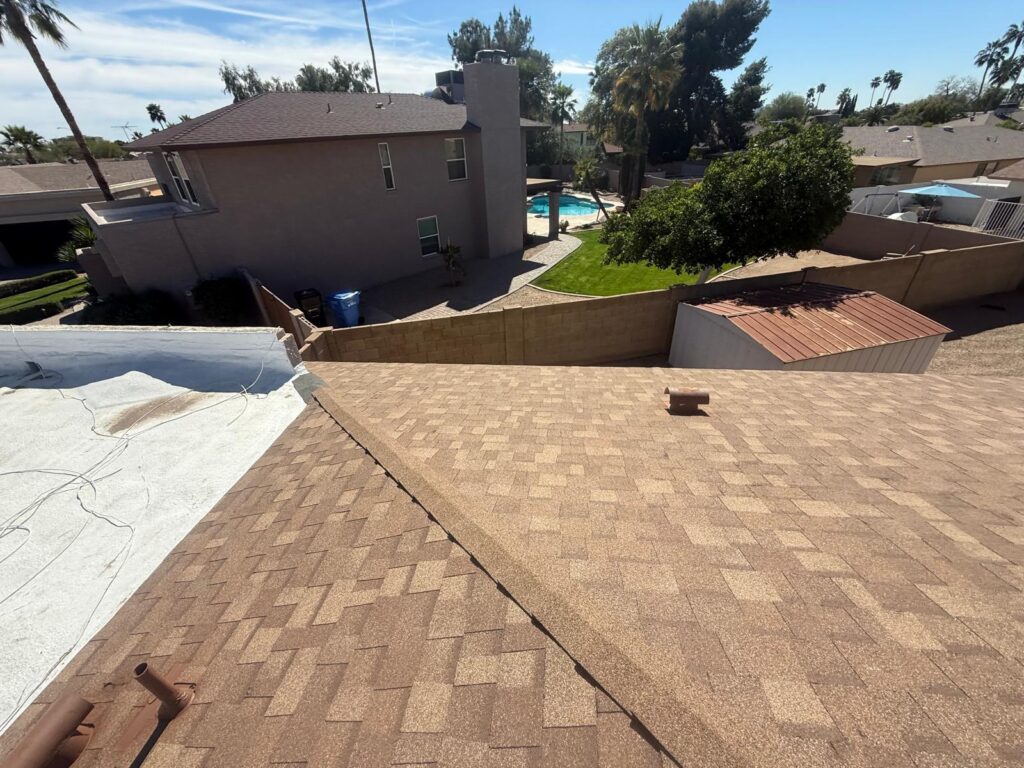
- Shingle roofs: ridge vents with continuous soffit intake are common and quiet.
- Flat and low-slope roofs: ventilation works differently, and some assemblies are unvented. Ask a roofer before adding any vent.
Signs your attic ventilation needs attention
- An attic that is extremely hot well into the evening.
- A second-floor bedroom that never cools down.
- Shingles that are curling or aging early.
- Signs of moisture, such as stained decking.
A roof inspection checks the vents, flashing and attic together, and our ventilation guide lists what to expect during a repair or upgrade.
Related reading and services
- Flat roofing, where ventilation works differently.
- Roof maintenance to keep vents, flashing and sealants in shape.
- Spanish tile roofs in Arizona and how vents fit into tile.
- How to find out when your roof was last replaced, useful before you add vents.
- Post-installation roof checklist for checking new vents and flashing.
- Roof replacement in Phoenix, the best time to upgrade ventilation.
Frequently asked questions
Is an attic fan better than a ridge vent?
Not automatically. A ridge vent with plenty of soffit intake is passive, quiet and has no motor to replace. A fan can help where passive exhaust is limited, but only if intake is adequate.
Do attic fans lower cooling bills?
They can reduce attic heat, but the effect depends on intake air, insulation and the home’s air sealing. A poorly balanced fan can raise cooling costs by pulling conditioned air into the attic.
Can I add vents myself?
Cutting into a roof adds leak risk. Have a licensed roofer size the ventilation and install the vents with proper flashing.
Does Tip Top Roofing Service install roof vents and attic fans?
Yes. We install and repair roof vents and attic ventilation and give free written estimates.
Next step
Not sure which setup fits your roof? Request a free estimate or call Tip Top Roofing Service at (480) 877-1643. We are at 6830 E 5th Ave Ste 205 in Old Town Scottsdale and serve Phoenix and the surrounding cities. ROC #355034, GAF certified, BBB accredited.
Last updated November 23, 2026. Reviewed by Lior Gabay, Tip Top Roofing Service.